Mon De Rijck · Mon De Rijck, Carl's father
Press
All the press devoted to Mon De Rijck, from 1975 to 1992: Truc-Troc and art safari clippings, Le Soir articles on Josaphat Park and Art Pool.
Truc-Troc press, 1975-1976
The press clippings devoted to the first two Truc-Troc editions at Château Malou.
12 document(s) · Open the chapter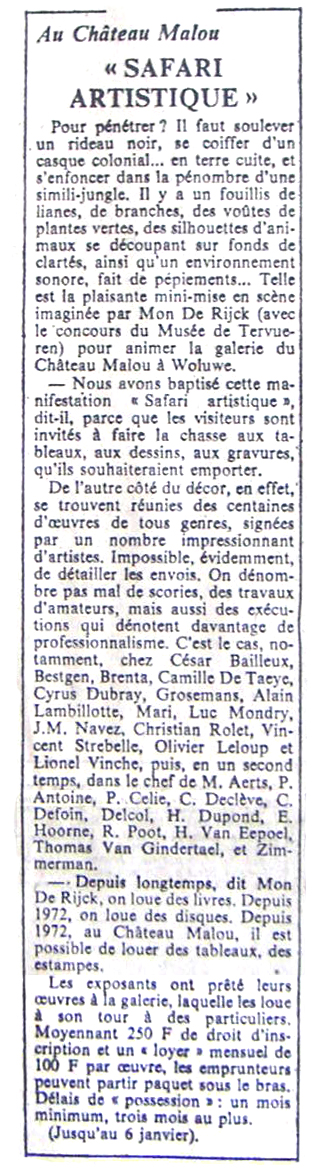
1976 - "Artistic Safari" at Château Malou
To put the lending gallery in the spotlight, Mon De Rijck turned the castle into a jungle: a terracotta colonial helmet, lianas, animals from the Tervuren Museum and an "art hunt". All the Art Safari press, from the 1976 clipping to The Bulletin's "Cover Story".
4 document(s) · Open the chapter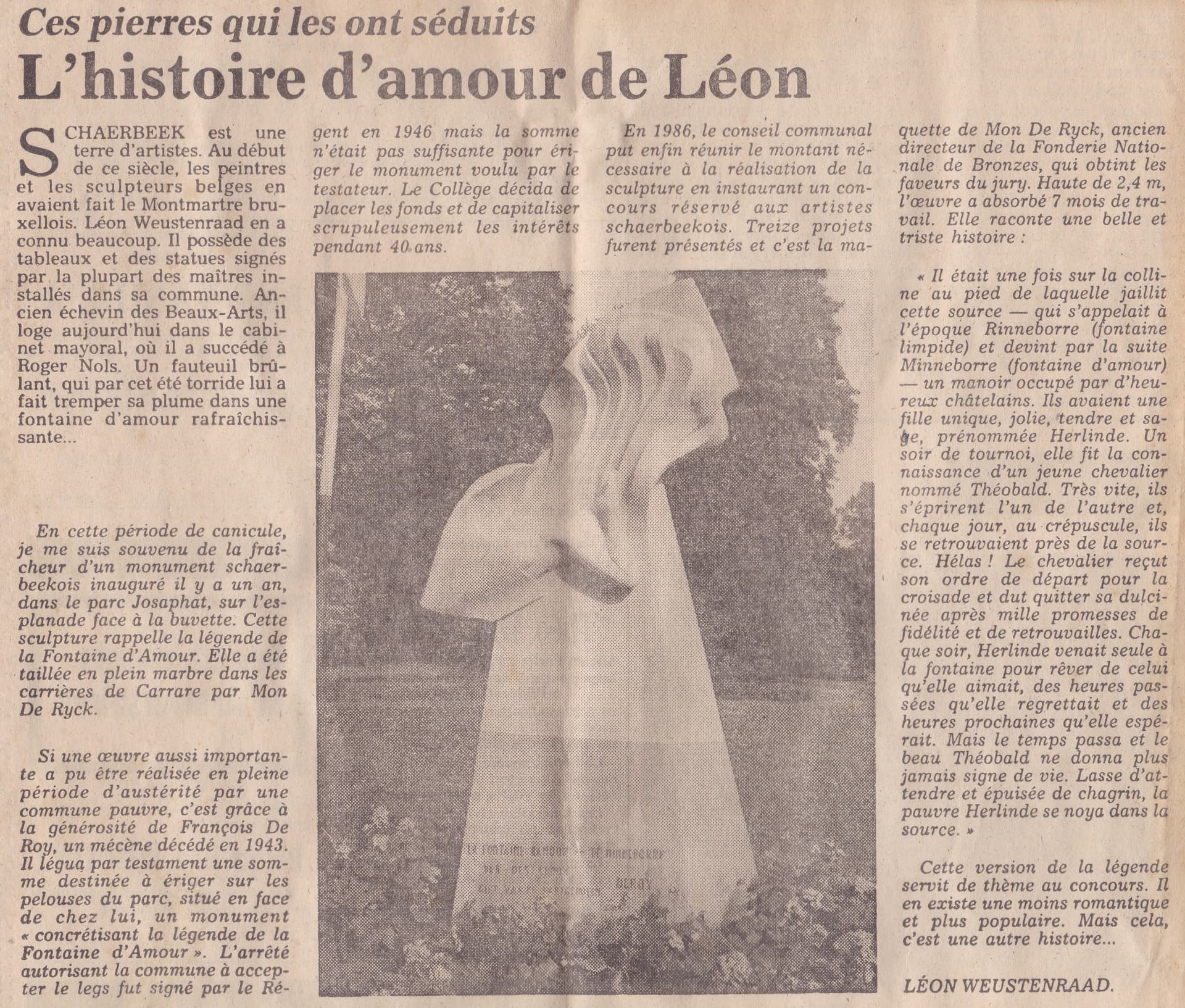
1988 - "The love story of Léon": the monument in Josaphat Park
On 28 May 1988, Le Soir devoted an article to the monument "The love story of Léon", created in Schaerbeek. The newspaper tells how the municipality was finally able to raise the necessary funds in 1986, forty years after the testator's bequest, to erect the work in Josaphat Park.
2 document(s) · Open the chapter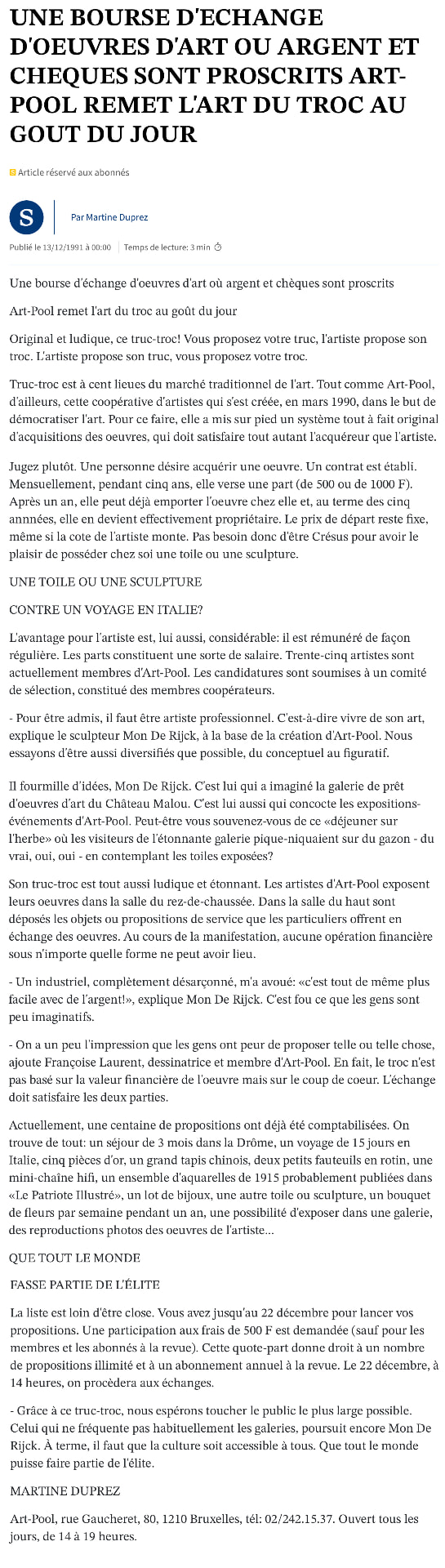
1991 - "Truc-Troc": Art Pool brings the art of barter back into fashion
On 13 December 1991, Le Soir published an article by Martine Duprez on Art Pool's "Truc-Troc": an artwork exchange fair where money and cheques are banned. Artists exhibit their works on the ground floor at 80 rue Gaucheret; upstairs, members of the public deposit objects and offers of services in exchange - a stay in the Drôme, a trip to Italy, gold coins, a Chinese rug, a weekly bouquet of flowers for a year.
1 document(s) · Open the chapter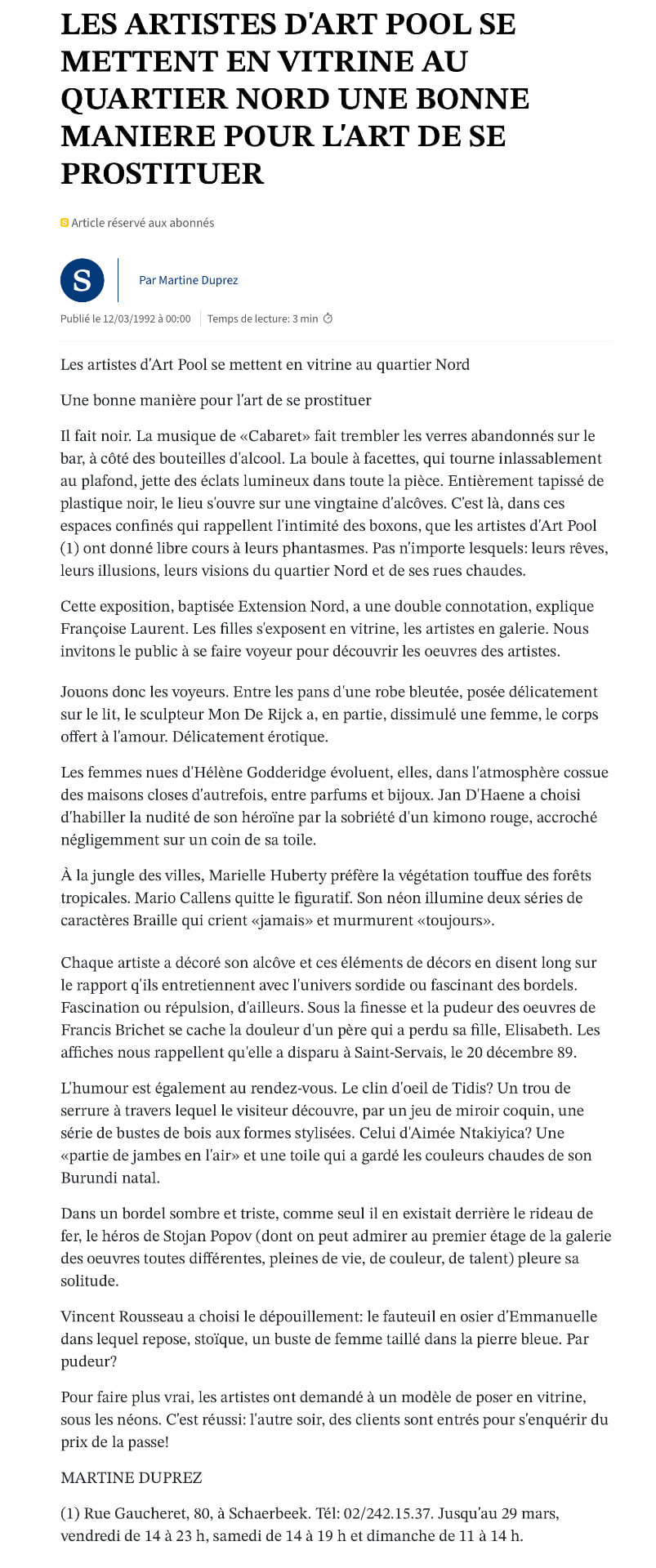
1992 - Art Pool in the North Quarter: "Extension Nord"
On 12 March 1992, Le Soir published an article by Martine Duprez about the "Extension Nord" exhibition, organised on the initiative of Mon De Rijck in the display windows of WTC 1, in Brussels' North Quarter, at the corner of Boulevard du Jardin Botanique and Boulevard Émile Jacqmain.
1 document(s) · Open the chapter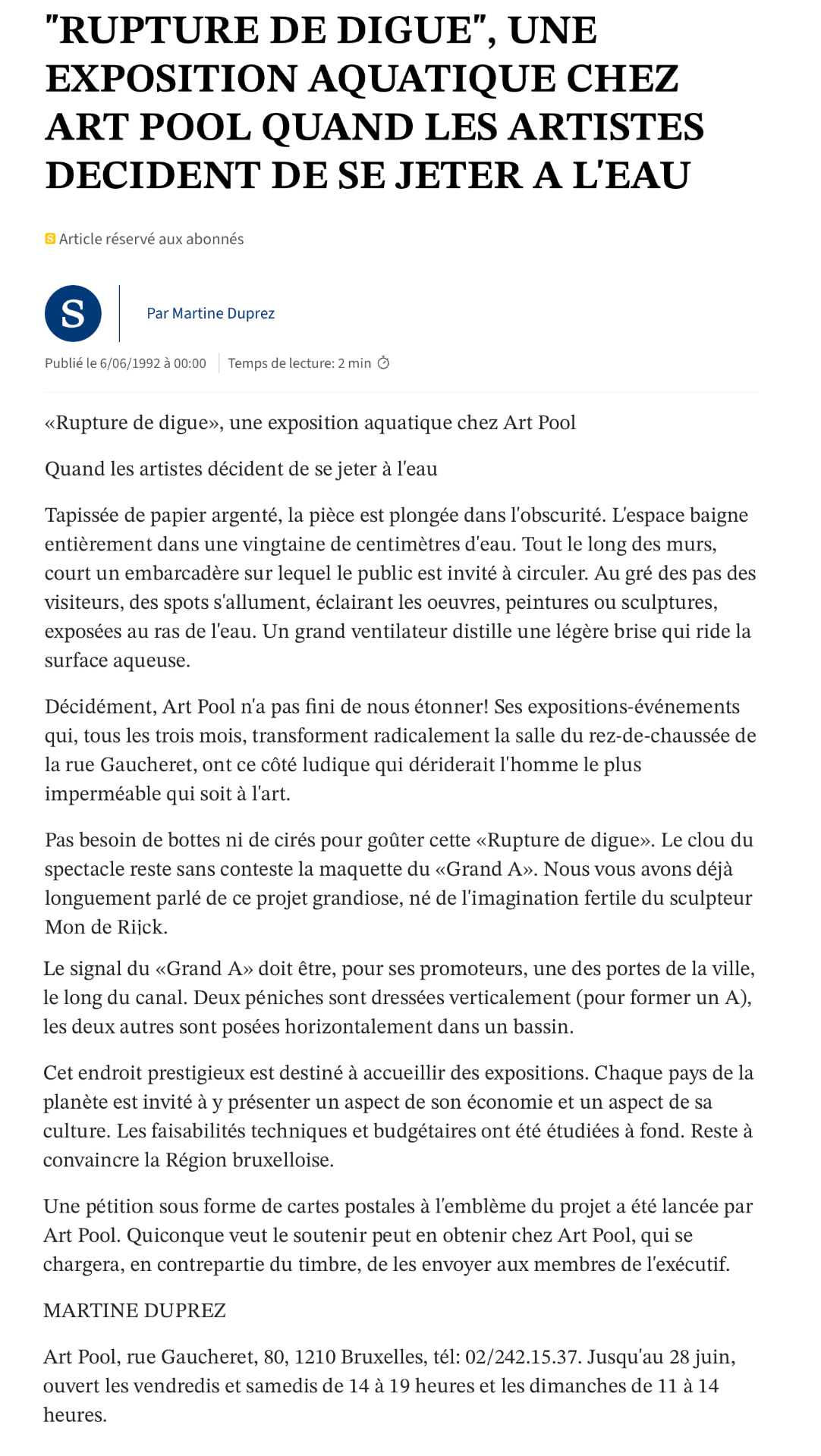
1992 - "Rupture de digue": Art Pool's aquatic exhibition
On 6 June 1992, Le Soir published an article by Martine Duprez on "Rupture de digue" ("Dam Burst"), an aquatic exhibition at Art Pool, rue Gaucheret in Brussels: a room lined with silver paper, plunged into darkness and covered with about twenty centimetres of water, where the public walks along a jetty while spotlights illuminate the works at water level.
1 document(s) · Open the chapter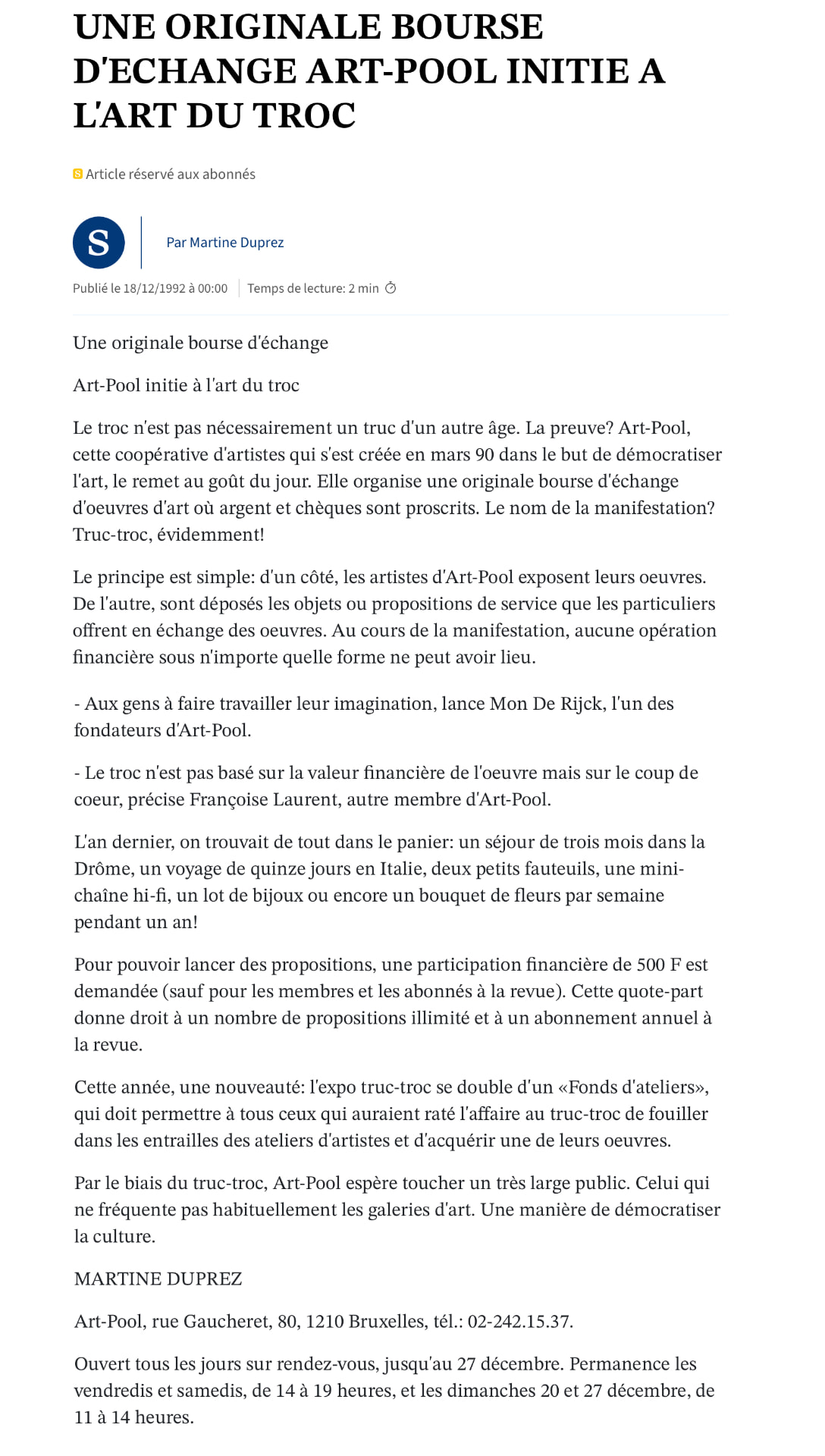
1992 - "Truc-Troc": second edition, with an "Artists' Studios Fund"
On 18 December 1992, Le Soir devoted a new article by Martine Duprez to the second edition of Art-Pool's "Truc-Troc", the artwork exchange fair where money and cheques are banned. "Barter is not based on the financial value of the work but on falling in love with it," explains Françoise Laurent, a member of Art-Pool, while Mon De Rijck, one of the founders, urges the public "to put their imagination to work".
1 document(s) · Open the chapterArt belongs to you - Mécénat Démocratique
Flyer for the Mécénat Démocratique non-profit, founded by Mon De Rijck and Charline Mahy. For 25 F, the holder of a support card can receive a painting or sculpture at home while supporting Belgian artists. The association promotes democratisation of art: shared workshops, art returned to public ownership, and an original redistribution of works.
Read the article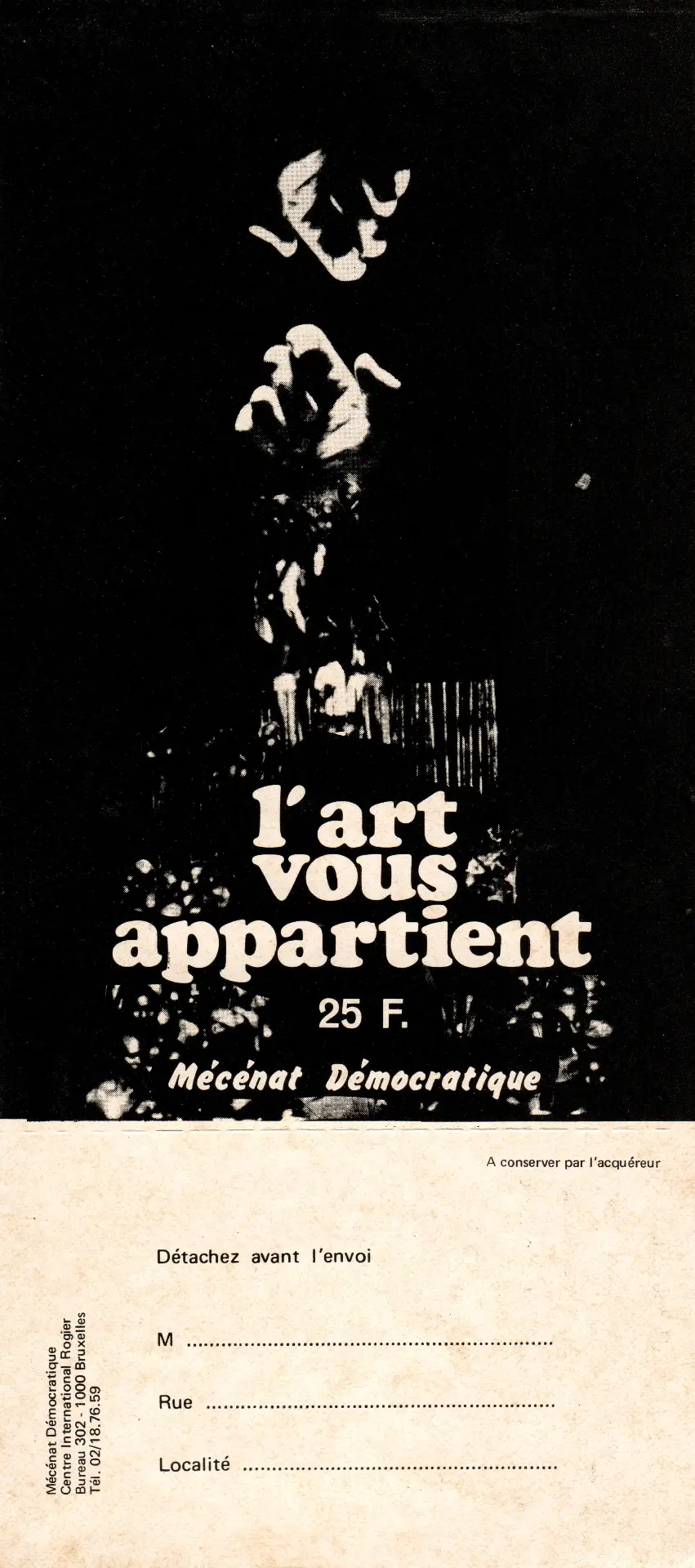
Contact Jeunes no. 2 - "With the fgtb, I have my say" - collage from Mécénat Démocratique
Issue 2 (March-April 1971) of Contact Jeunes, the monthly of the F.G.T.B. Cadets and Young Trade Unionists, devoted to the social elections. The magazine reproduces a full-page collage kindly authorised by "Mécénat démocratique", the non-profit run by Charline Mahy and Mon De Rijck, and publishes a box setting out the association's aims: bringing art within reach of the general public, allowing artists to live from their art, fighting bad taste, creating shared workshops for artists and young people, and ensuring painting and sculpture become public property again. The association states it groups 243 artists and holds 8,000 works of art.
Read the article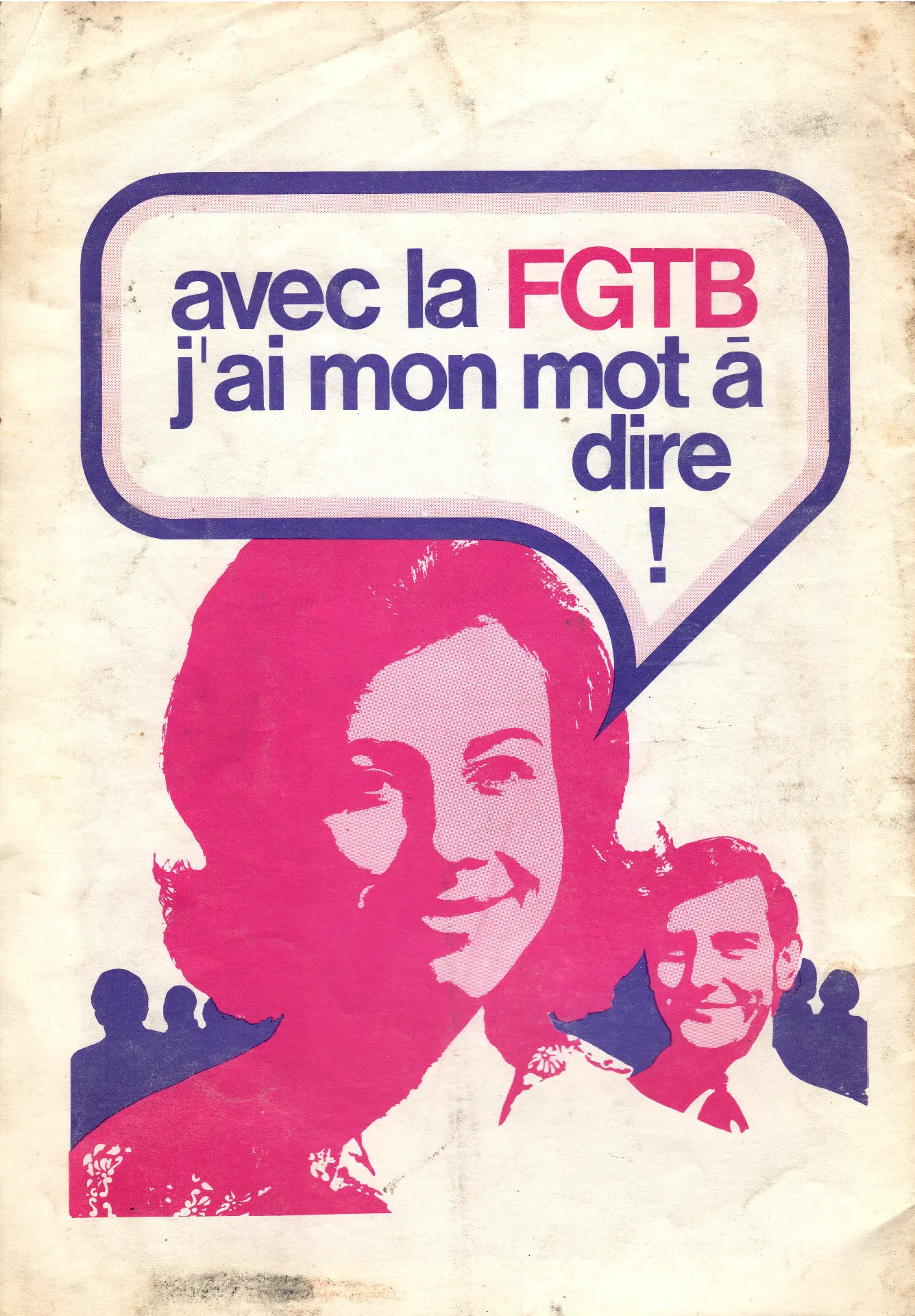
Two hundred young Belgian painters are ready to barter their canvases for any object, in Woluwé-Saint-Lambert
Announcement of the Truc-Troc in June 1975: from 14 June to 30 August, two hundred young Belgian painters will exchange their canvases for any object at Château Malou - "from the old oil lamp to the superb villa". The exhibition is described as "unquestionably the largest group Salon ever organised in Belgium", with a selection jury, and the principle is explained: "Because money isn't everything" - trading what you love for what you love.
Read the article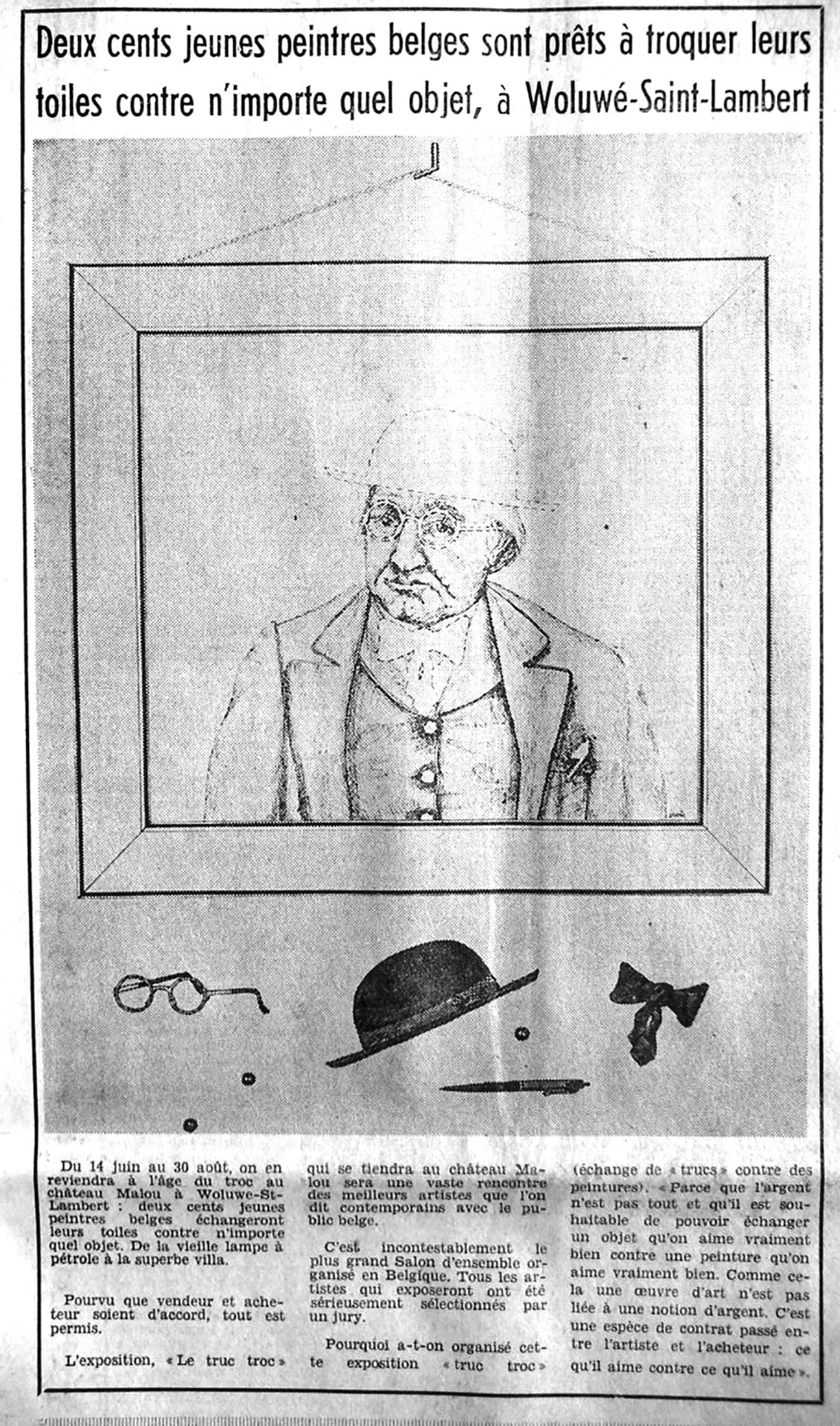
Château Malou: bartering an object for a painting
A small illustrated item from June 1975: "If you give up... for lack of means, on acquiring a work of modern painting, try calling in at the Truc-Troc, which has just opened at Château Malou in Woluwe and will run for several weeks." The article sums up the principle: each artist is ready to exchange a painting, "not for cash or banknotes, but for an object the collector no longer likes and which... the artist would like". "In short, you don't buy, you barter." Address and dates: Château Malou, 45 chaussée de Stockel, Woluwe-Saint-Lambert, until 30 August.
Read the article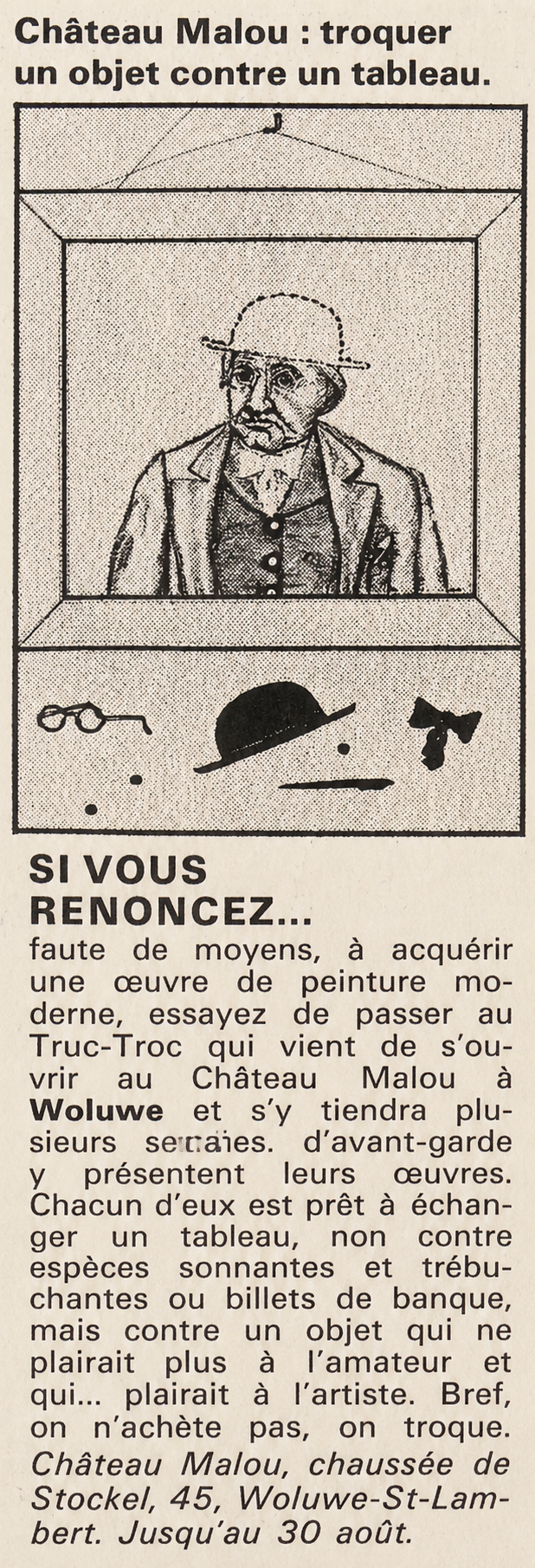
"Truc-Troc... from the seat belt to the Picasso (?)"
The article places the truc-troc in the wake of artist Tomek Kawiak's "Troc-Art" and presents the Château Malou non-profit "La Galerie des prêts d'œuvres d'art", with around a thousand works available for a 100 F monthly rent and a 250 F registration fee. Nearly two hundred artists exhibit from 14 June to 30 August; an Artists' ball follows the opening on Saturday 14 June.
Read the article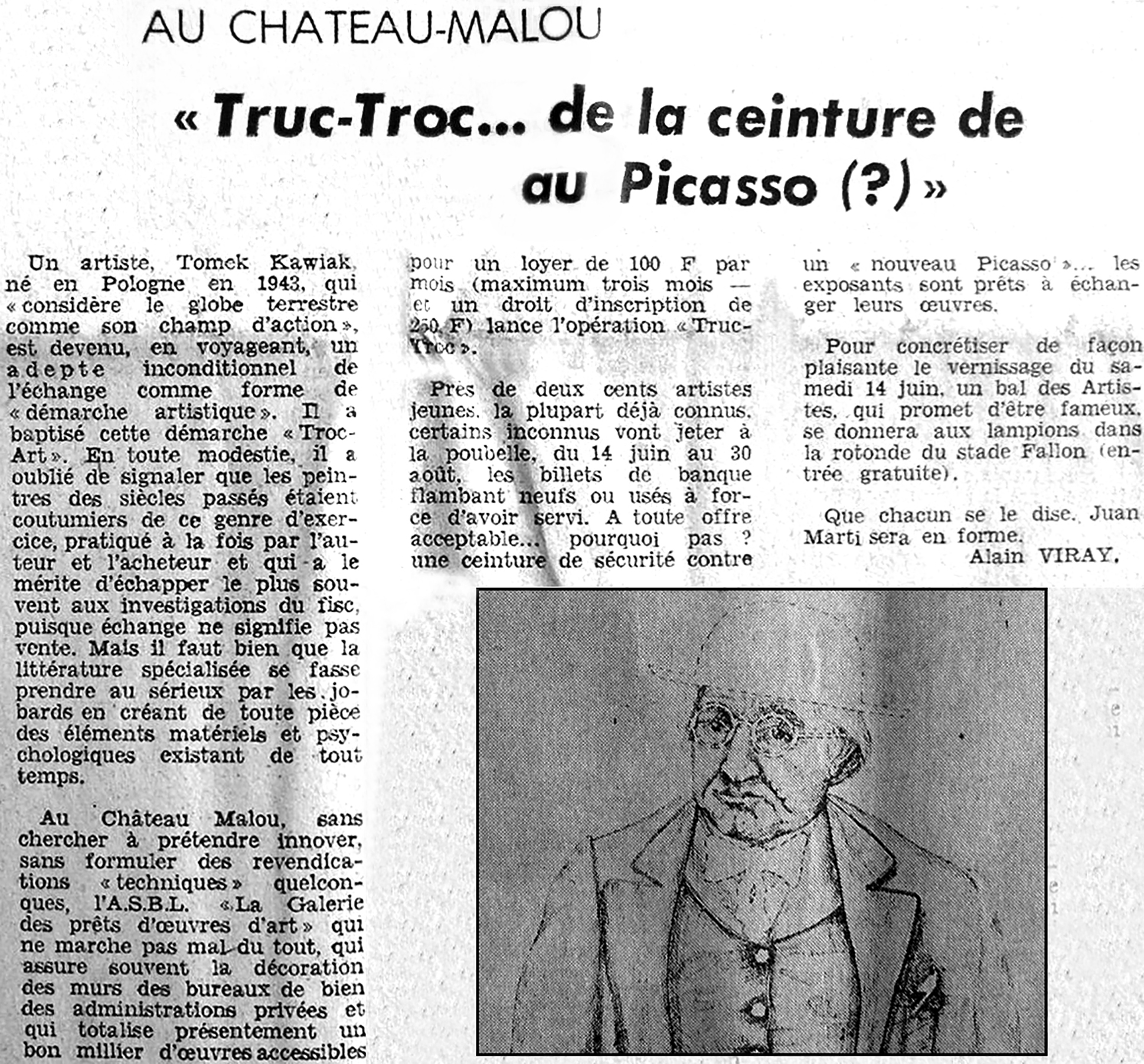
At château Malou: Success for the Truc-Troc
The Woluwe-Saint-Lambert artwork lending gallery is running until 30 August an event built around 200 contemporary Belgian artists: 200 high-quality works are exchanged for 200 objects offered by the public. The article notes that the success exceeds all the organisers' expectations and recalls the opening hours, until 31 August, from 10 am to 7 pm, at château Malou, chaussée de Stockel, 45.
Read the article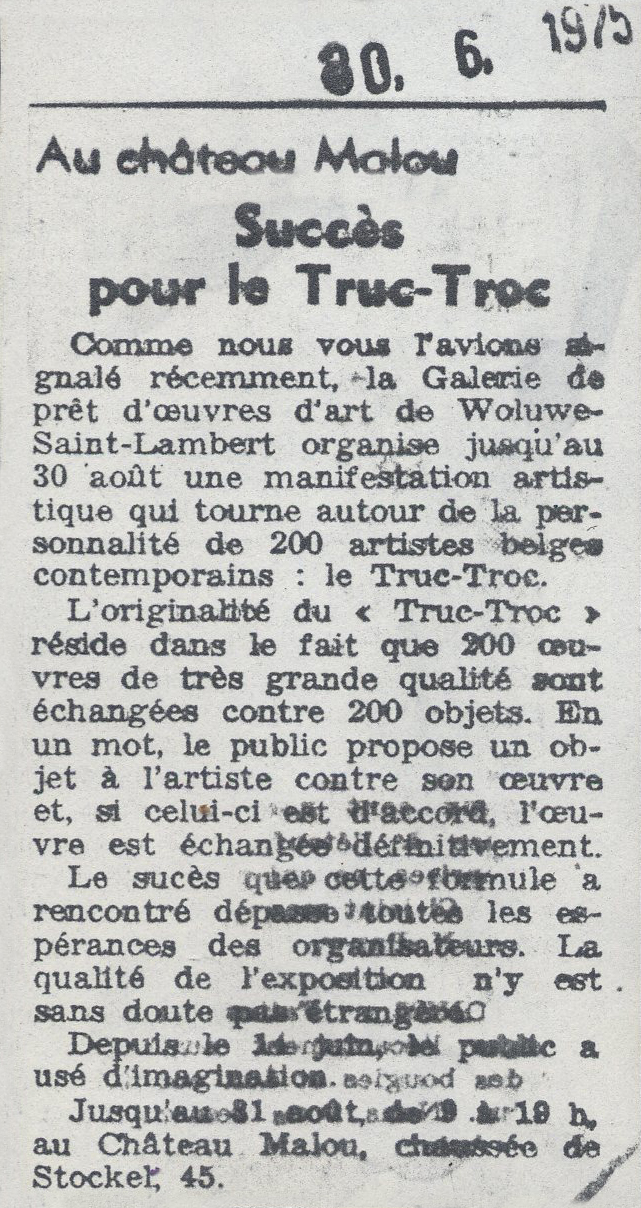
Japan for a nude - the truc troc at Château Malou
Report by the magazine Spécial on the very first truc troc operation, organised by the Galerie de Prêts d'œuvres d'art at Château Malou in Woluwe: around 200 artists showed works exchangeable for any object or service. The article names Rik Poot, Roger Somville, Marianne Dock, Gheyssens, Bailleux, Peter Celie, Marchoul, Vic Gentils and Strebelle among the participants, and details the offers received (a trip to Japan, a stay in Corsica, a Skoda car, a violin from Lola Bobesco, a bicycle from Eddy Merckx, 20 kilos of glue for Claude Rahir).
Read the article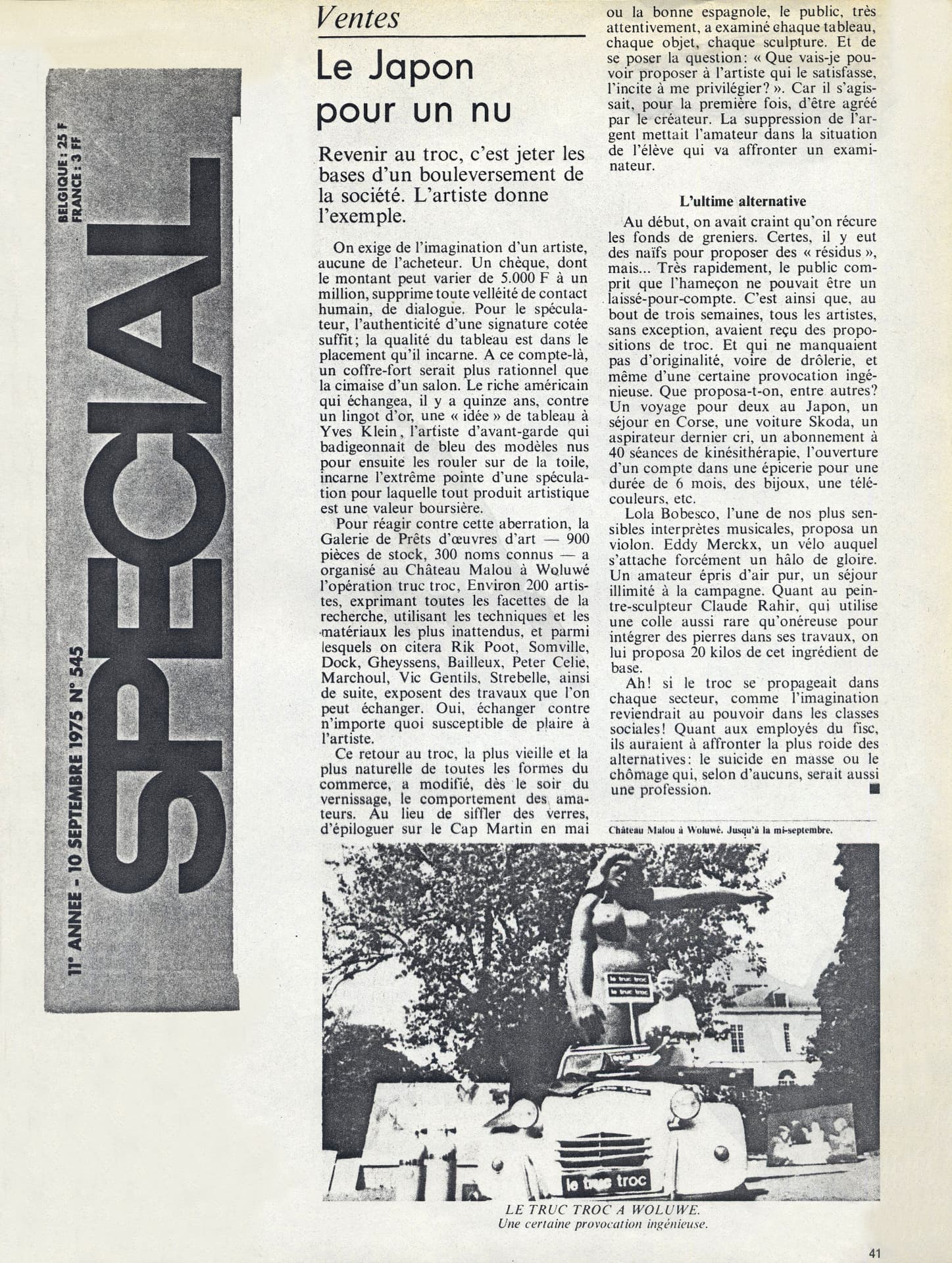
Le truc-troc
Two hundred artists show works at château Malou to be exchanged for an object, until 27 October, daily from 2 to 7 pm. The article stresses a non-profit organisation whose only aim is to support the artists, with a considerable cultural impact.
Read the article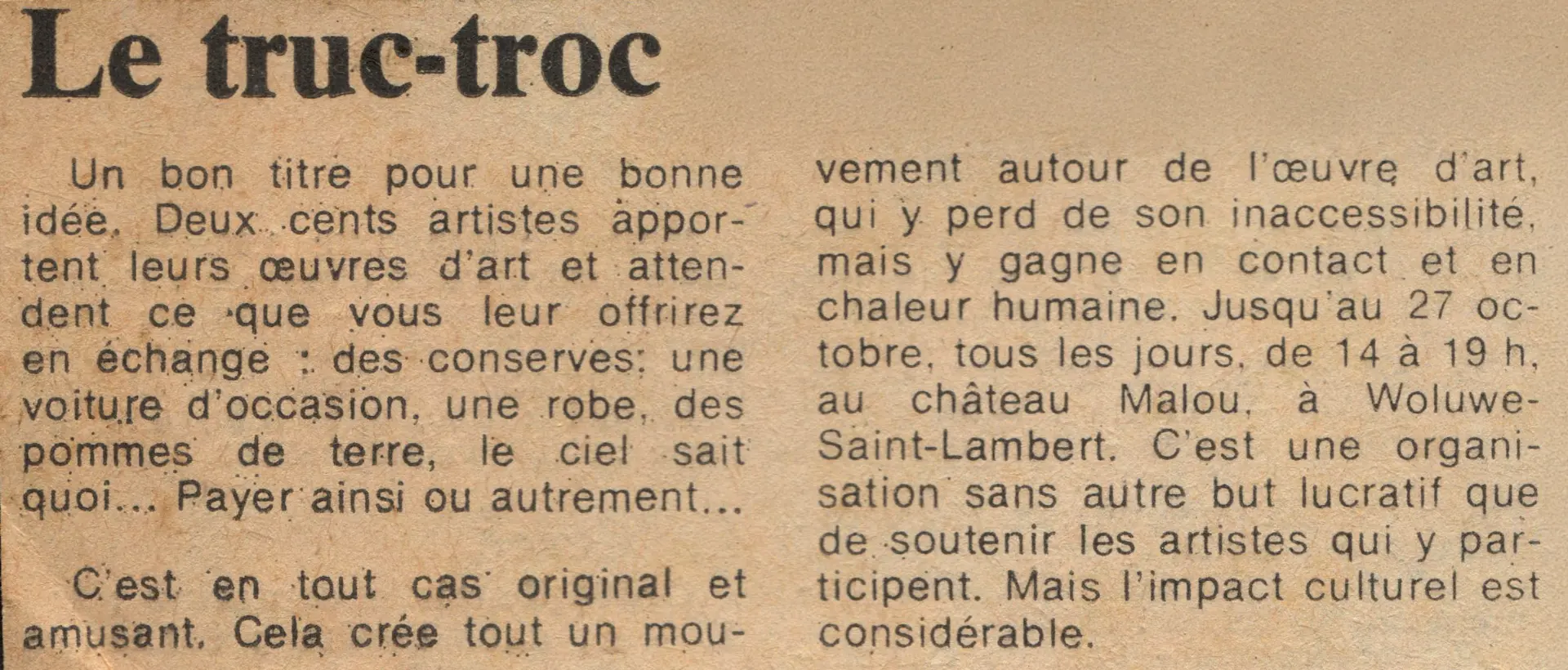
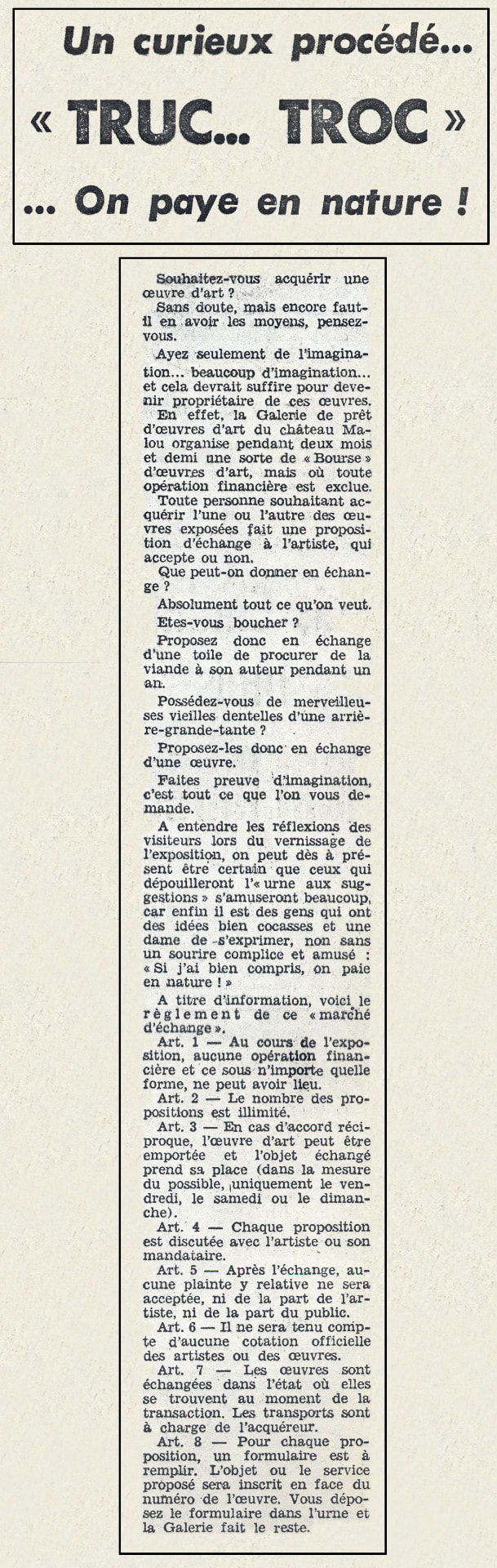
A curious device... "Truc... Troc" ... You pay in kind!
The article explains the principle of the truc-troc run for two and a half months by the château Malou artwork lending gallery: an art "exchange" from which any financial transaction is excluded, where anyone offers an object or a service to the artist, who accepts or not. It publishes the full eight-article rules of the "exchange market": no financial transaction, unlimited number of proposals, definitive exchange upon mutual agreement, discussion with the artist or their representative, no complaint after an exchange, no official price rating taken into account, works exchanged as they stand with transport at the buyer's expense, and a form to be dropped in the ballot box.
Read the articleAt Château Malou: le truc troc, a world first
Claude Muyls presents the truc troc as a world first and recalls how the Galerie de Prêts d'œuvres d'art, founded at Château Malou in 1972, works: 960 works in stock, some three hundred artists, a 250 F registration fee and 100 F rent, exhibitions with Passage 44 and the Woluwe Shopping Center, international exchanges with Tunisia, the 500-5000 operation. Nearly two hundred young artists exhibit until the end of August works exchangeable for any object, except money.
Read the article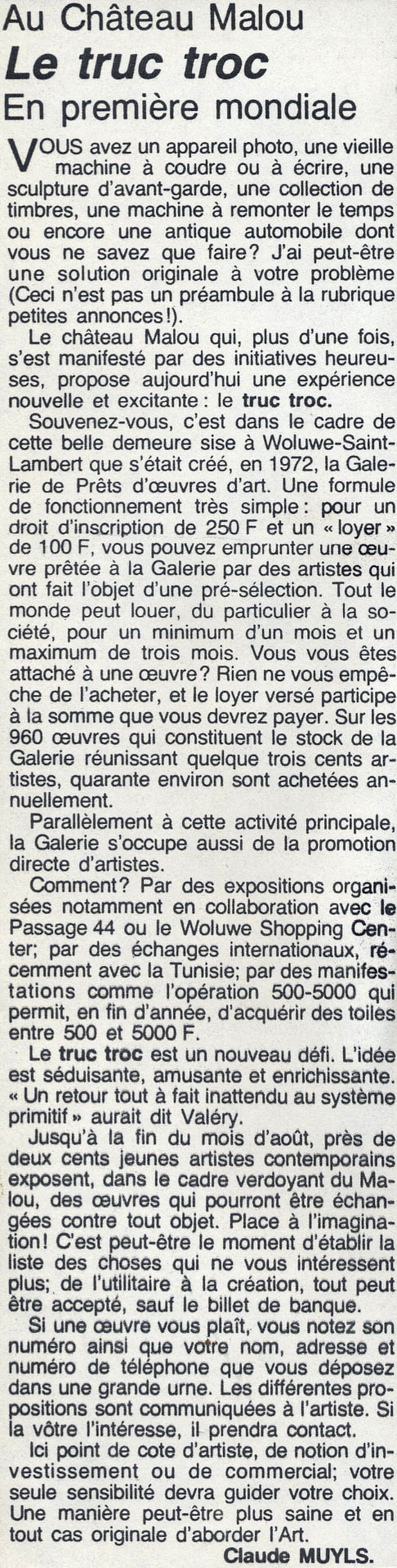
Enjoy yourself at the truc-troc
Announcement of the first truc troc edition at Château Malou, chaussée de Stockel in Woluwe-Saint-Lambert, from 14 June to 30 August: everyone sorts out their junk and comes to negotiate an exchange for a lithograph or a drypoint. The article also recalls the artwork rental scheme launched a few months earlier.
Read the article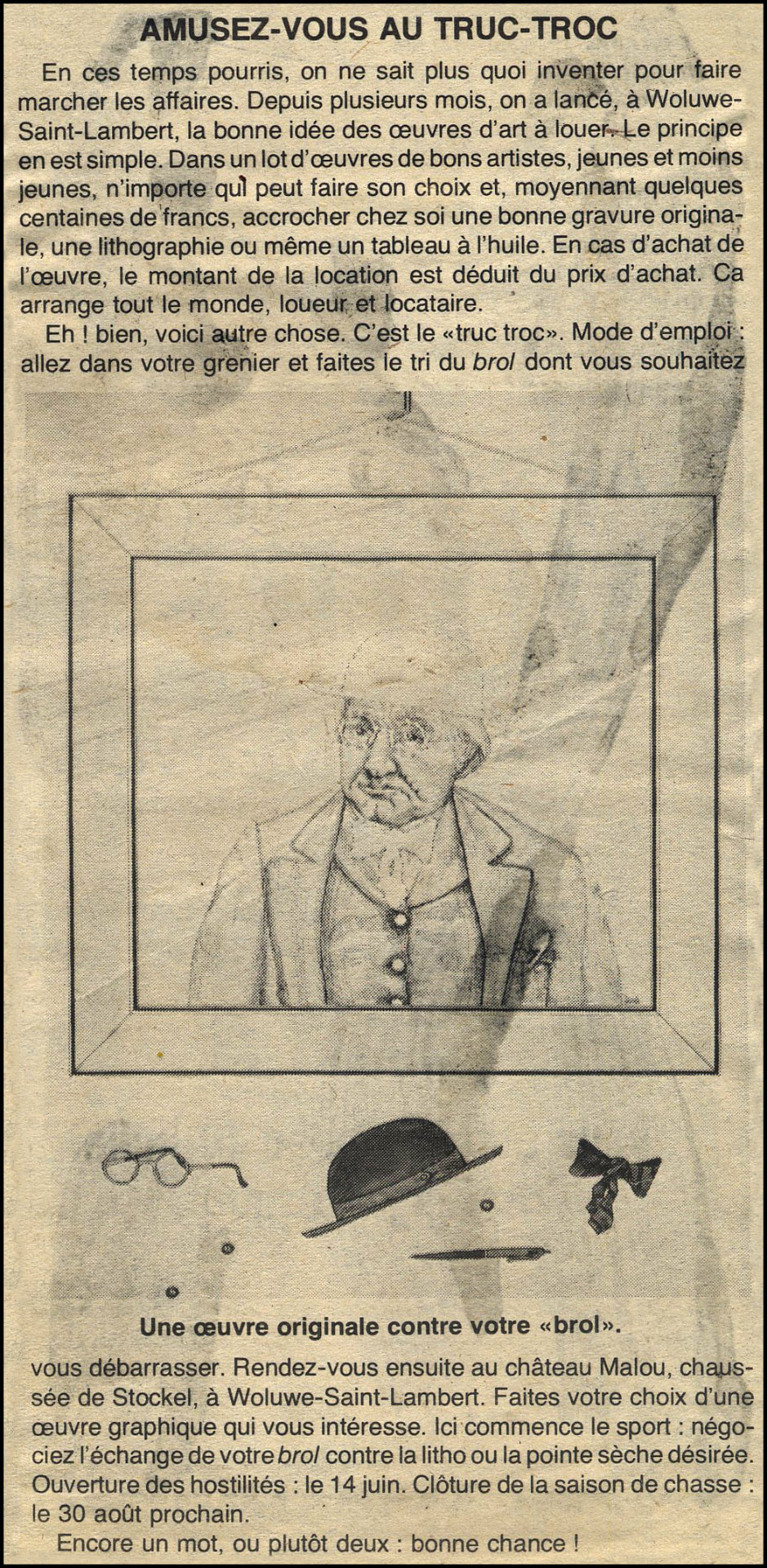
Pictorial truc-troc at Château Malou
Published in the "Arts, Sciences et Lettres" section in June 1975, this article announces the Truc-Troc ahead of its opening: "It will be a vast gathering of the best young contemporary artists", nearly 200 of them each presenting one work at Château Malou, Woluwe-Saint-Lambert, from 14 June to 30 August - "no doubt the largest event of its kind ever organised in Belgium".
Read the article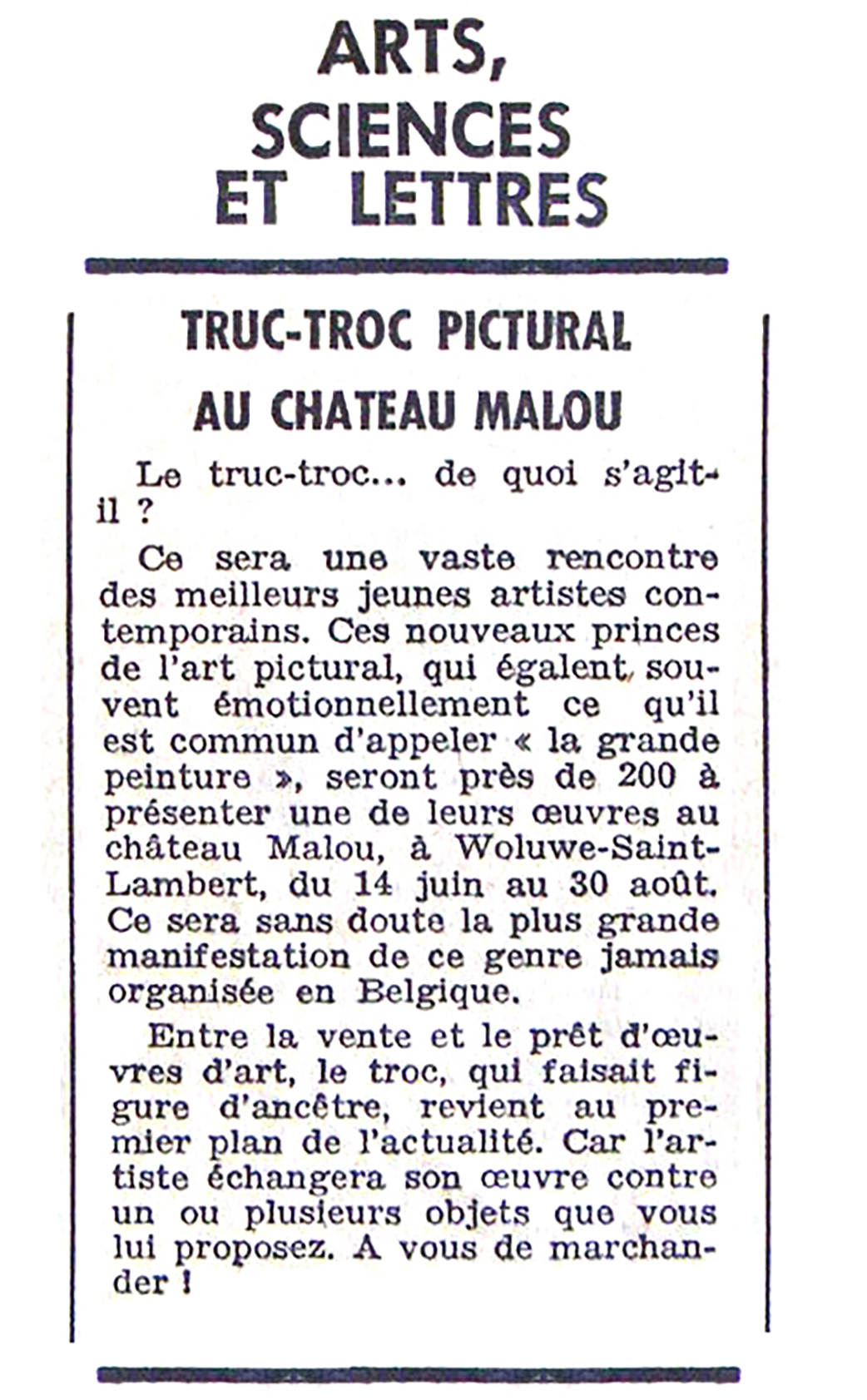
Le Truc Troc - letters to the editor: "From Mrs N. Delépine, Brussels"
Letters to the editor in Spécial magazine: Mrs N. Delépine, from Brussels, praises the Truc-Troc initiative at Château Malou, discussed in the article "Japan for a nude": "much more than original: it is intelligent". She stresses that commerce is secondary, that the art lover finally takes part, and that the formula "overturns the conformism attached to the art market".
Read the article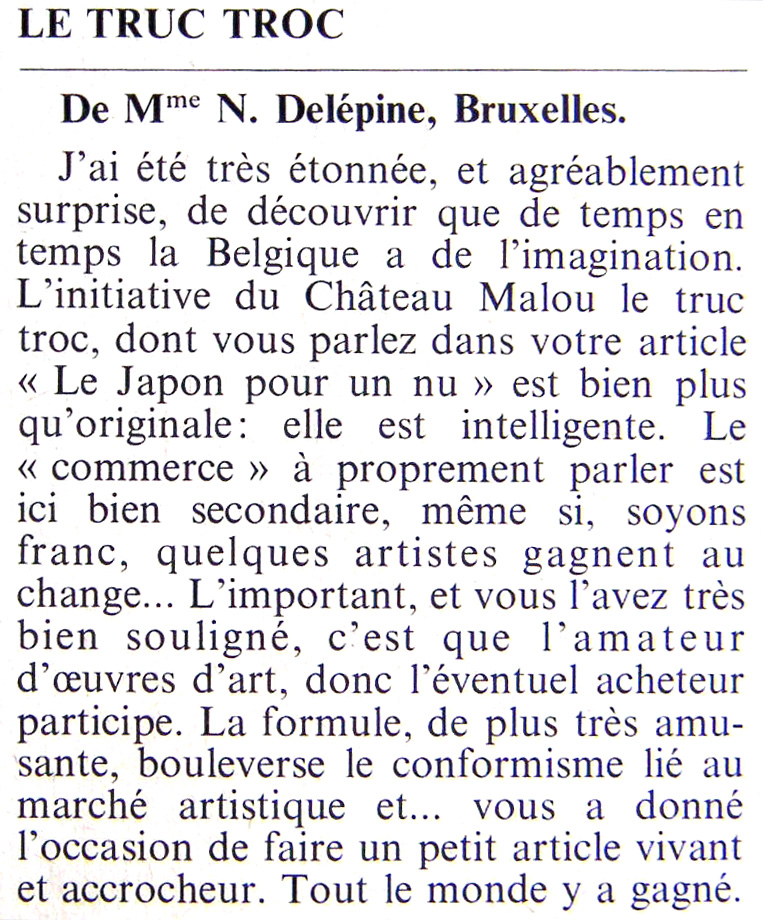
The lending gallery made new: "Three years is enough!"
Three years after its creation, the Woluwe-Saint-Lambert lending gallery is completely renewed: all works were returned to the artists, who were asked to submit five new creations to the jury, for a new selection of 800 works presented at château Malou from 27 February to 21 March 1976 (opening on 26 February at 7 pm with Fernand Callebert's total audiovisual show, first prize at the Knokke Festival). The article also announces the 500-5000 Operation's departure for Amsterdam and probably Paris, and names Pierre Levie, president, and Mon De Rijck, director of the gallery.
Read the article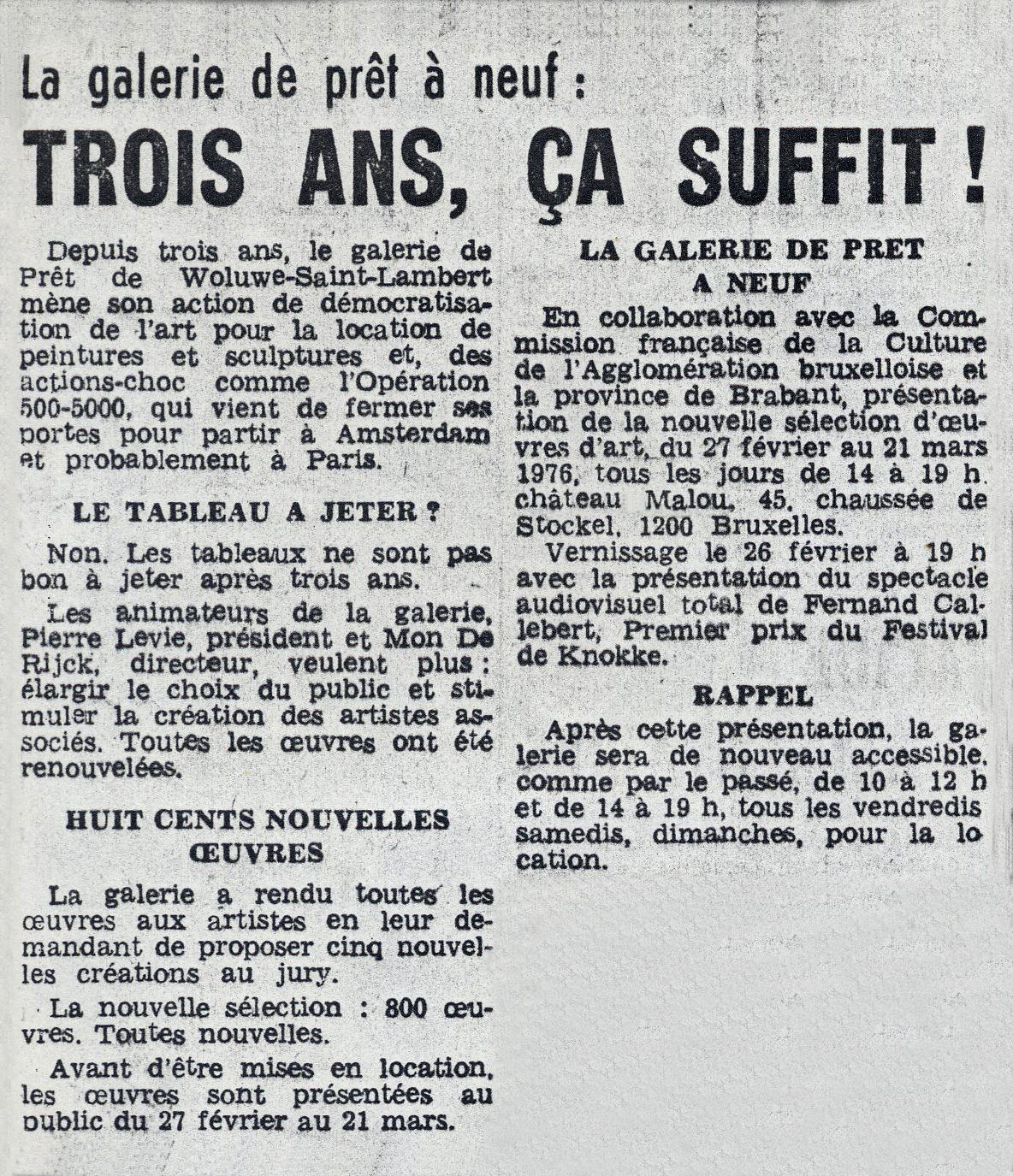
Woluwe-St-Lambert: artwork lending
Presentation of the Château Malou artwork lending gallery, created in April 1972: several hundred paintings, sculptures, engravings and screenprints lent one to six at a time, for a minimum of one month and a maximum of three. The gallery runs free exhibitions and aims to free the artwork from its financial implications.
Read the article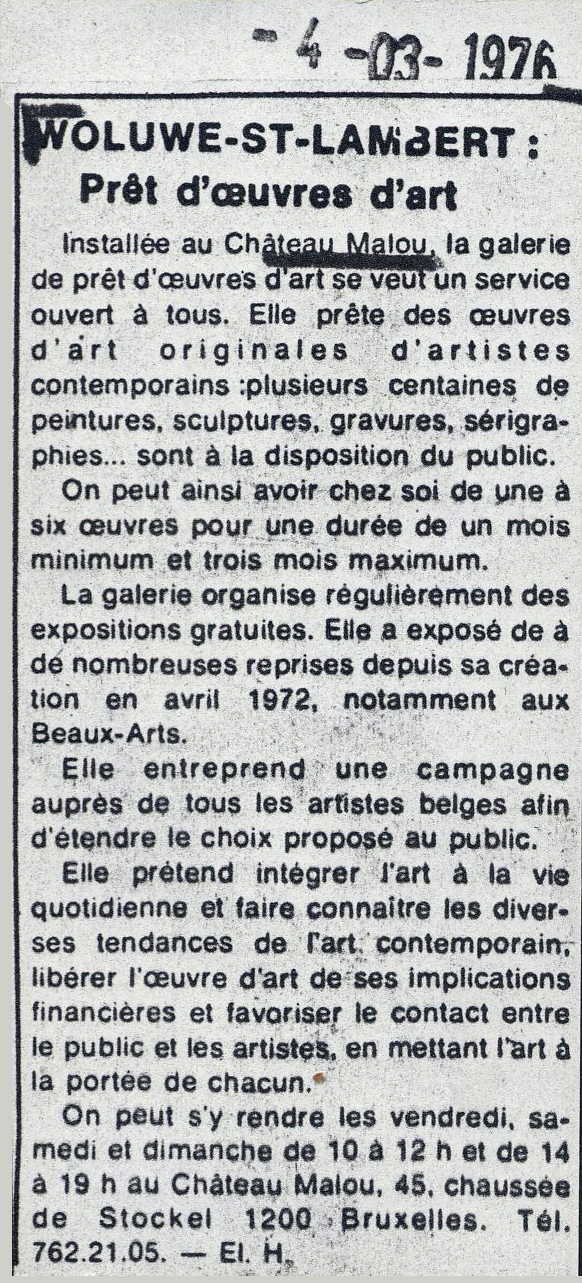
At Château Malou: "Artistic Safari"
A 1976 article describes the "Artistic Safari" devised by Mon De Rijck, with the help of the Tervuren Museum, to enliven the Château Malou gallery in Woluwe: a black curtain, a terracotta colonial helmet, a mock jungle, lianas, animal silhouettes and chirping sounds. Visitors are invited to "hunt" for the paintings, drawings and prints they would like to take home. The article lists the artists (César Bailleux, Bestgen, Brenta, Camille De Taeye, Cyrus Dubray, Grosemans, Alain Lambillotte, Mari, Luc Mondry, J.M. Navez, Christian Rolet, Vincent Strebelle, Olivier Leloup, Lionel Vinche and others) and recalls the artwork rental principle: 250 F registration fee and 100 F monthly rent per work.
Read the articleThe artistic safari of Château Malou
In its Culture section, Le Soir presents the "artistic safari" devised by the Château Malou artwork lending gallery: the visitor becomes an "art hunter", greeted by a few African animals borrowed from the Tervuren Museum, a mini-jungle and a soundscape of roaring beasts and chirping birds. The article lists some eight hundred works, none exceeding 7,000 francs "according to the gallery's democratic principle", and names Christian Rolet, César Bailleux (sculpted forms), Erik Leloup (mini-sculpture), Vincent Strebelle (jewel bicycles), gouaches and watercolours by Luc Mondry and Arthur Grosemans, engravings and drawings by Roland Delcol, drawings and silkscreens by Lionel Vinche. Address and opening hours in a footnote: Château Malou, 45 chaussée de Stockel, 2 to 7 pm, until 6 January.
Read the article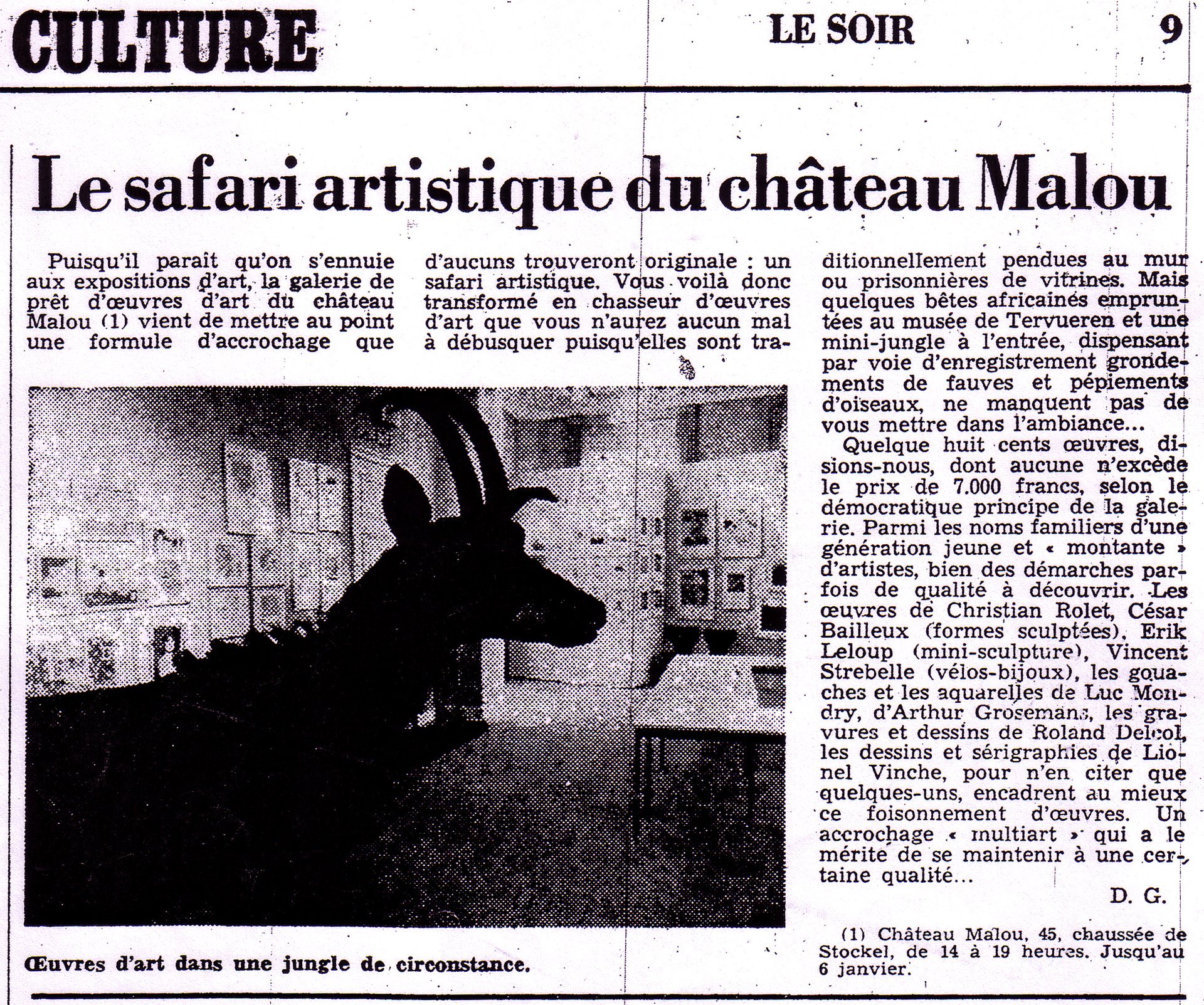
At Château Malou: "Be art hunters"
December 1976 article signed A.V. inviting readers to be "art hunters" at Château Malou. Profile of Mon De Rijck, a sculptor born in Ninove and former director of the National Foundry, recalling the Truc-Troc, "5.000 - 5.000", the "Labyrinth of Mirrors" and "L'anti-antipeinture". For the "Artistic Safari", made with the Central Africa Museum, the visitor in a terracotta explorer's helmet emerges onto some two hundred works by about two hundred artists, none exceeding 7,000 F (Arty, Delcol, De Taye, Dubray, Grosemans, Lambillotte, Mahy, Mondry, Rolet, Strebelle, Toledo, Van Gindertael, Vinche, Zimmerman…). Photo of Mon De Rijck in explorer's outfit.
Read the article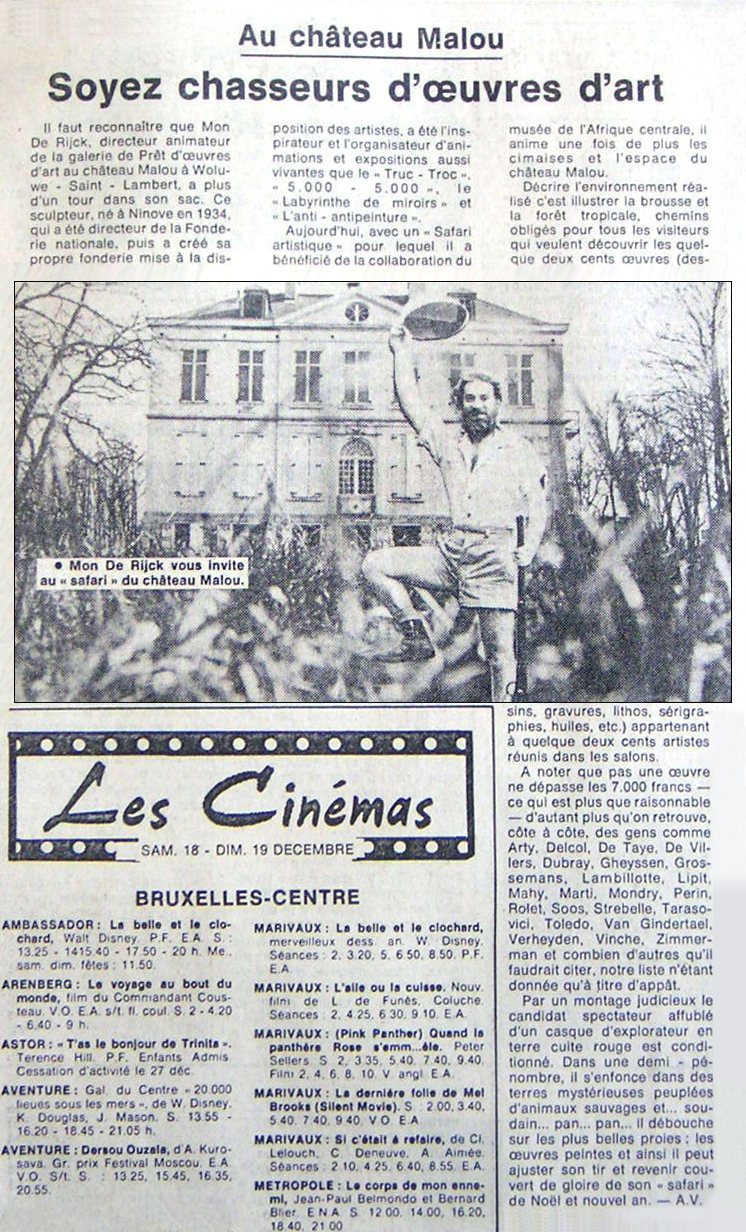
Art Safari in the Suburbs
Issue of the English-language magazine The Bulletin of 24 December 1976 whose cover featured Mon De Rijck (the safari poster). The interior "Cover Story", "Art Safari in the Suburbs" by Harold Bishop, describes the recreated jungle at Château Malou, the works by more than one hundred artists on sale for 700 to 7,000 BF, and introduces Mon De Rijck, a 33-year-old sculptor and director of the Art Loan Gallery. The article recalls the Truc-Troc 500-5,000 and the Labyrinth of Mirrors, and announces the exhibition's move to the Van Gogh Museum in Amsterdam the following year.
Read the article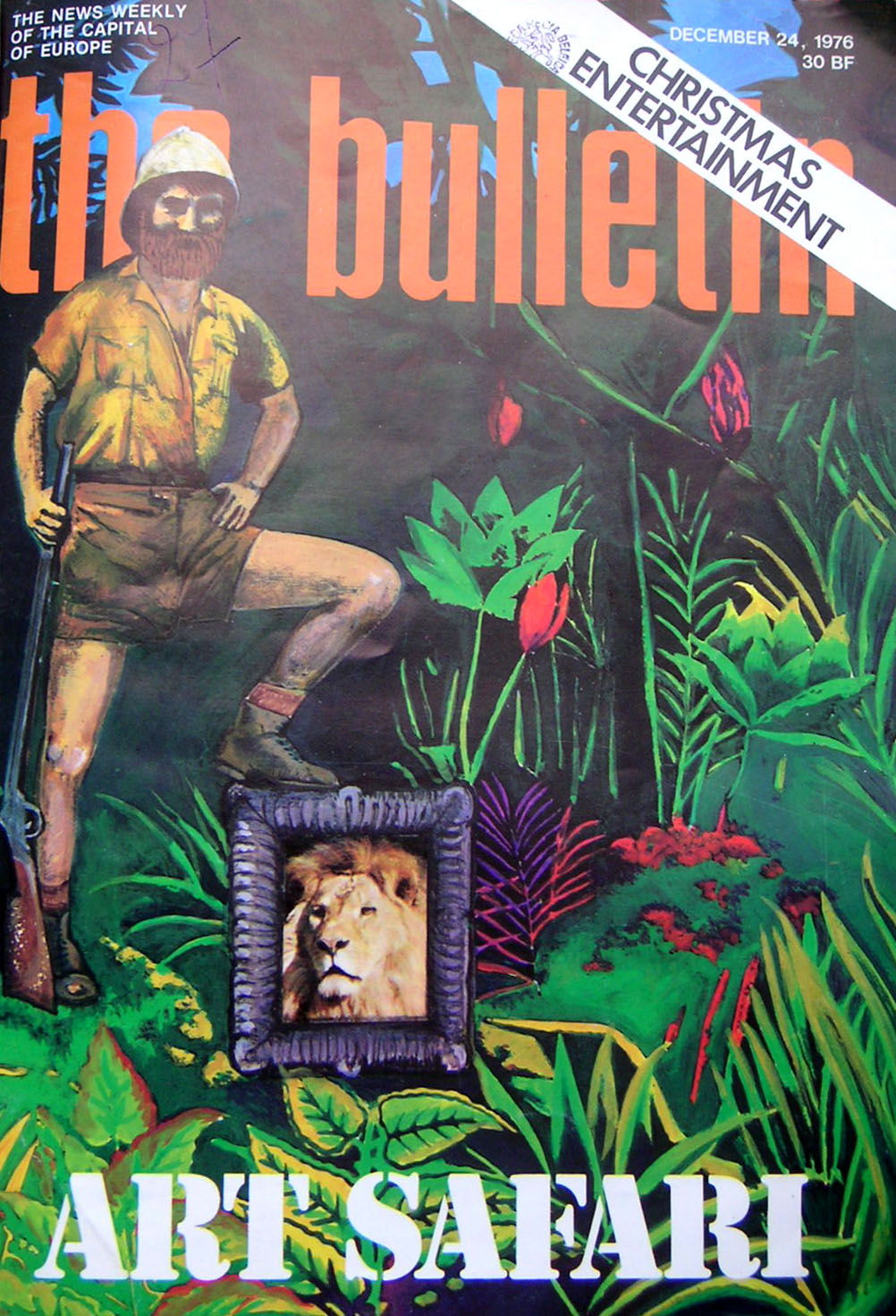
Echos de partout: two hundred works of art to exchange
Second Truc-troc edition: the Château Malou artwork lending gallery brings together sixty artists and some 200 selected paintings and sculptures, from 7 to 22 October, 2 to 7 pm, 45 chaussée de Stockel, 1200 Brussels.
Read the article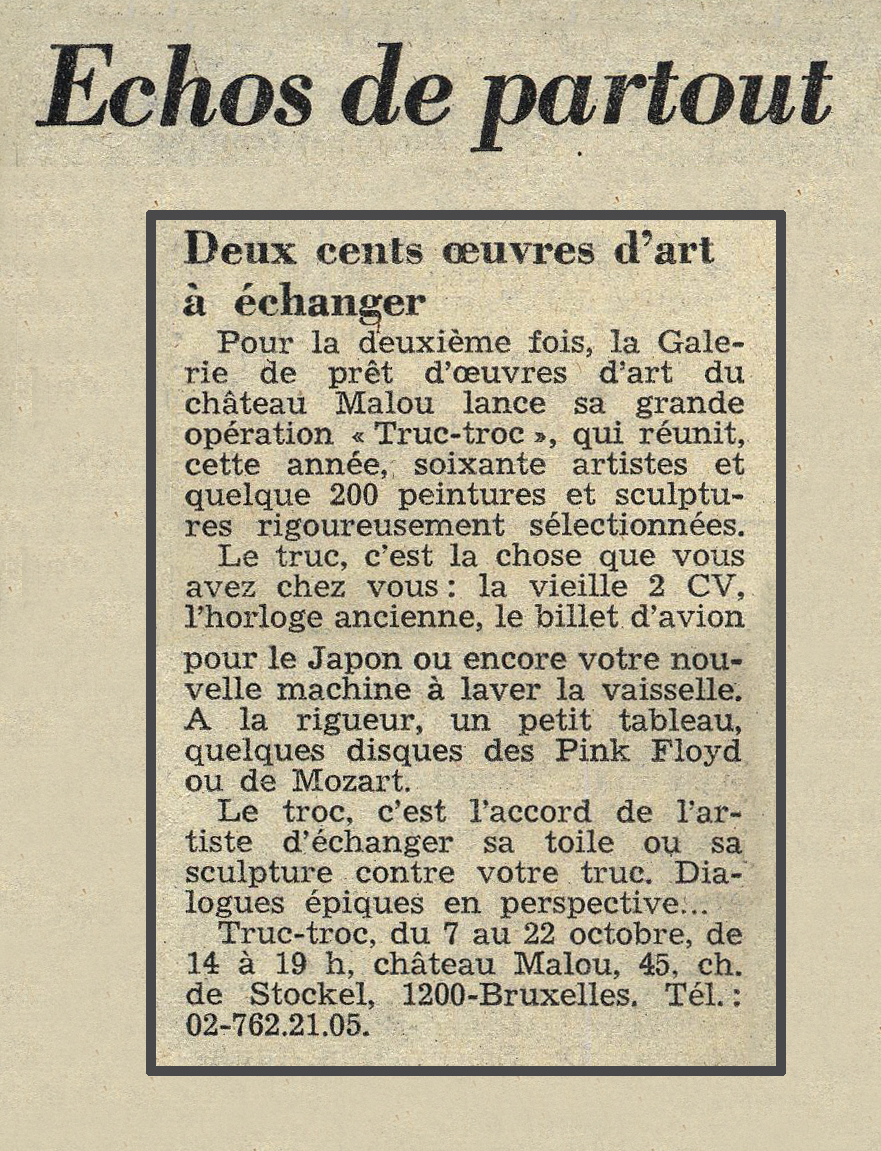
New collection of works (800) at the Woluwé-Saint-Lambert art lending gallery
From 27 February to 21 March, the art lending gallery presents an entirely renewed collection of eight hundred works. The article names Mr Pierre Levie, chairman, and Mr De Rijck, director, who asked the associated artists for five new creations each; eight hundred works were selected and are on show at château Malou, 45 chaussée de Stockel.
Read the article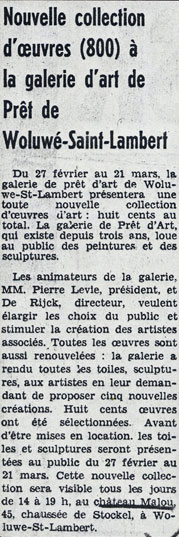
The Woluwe-Saint-Lambert lending gallery has renewed its stock of works
Three years after its creation, the Woluwe-Saint-Lambert lending gallery has entirely renewed its works: eight hundred of them, shown to the public from 27 February to 21 March, daily from 2 to 7 pm, at château Malou, with an opening on 26 February at 7 pm and the total audiovisual show by Fernand Callebert, first prize at the Knokke Festival. The article also mentions the departure of "Operation 500-5,000" for Amsterdam and probably Paris, and names the organisers Pierre Levie and Mon De Rijck.
Read the article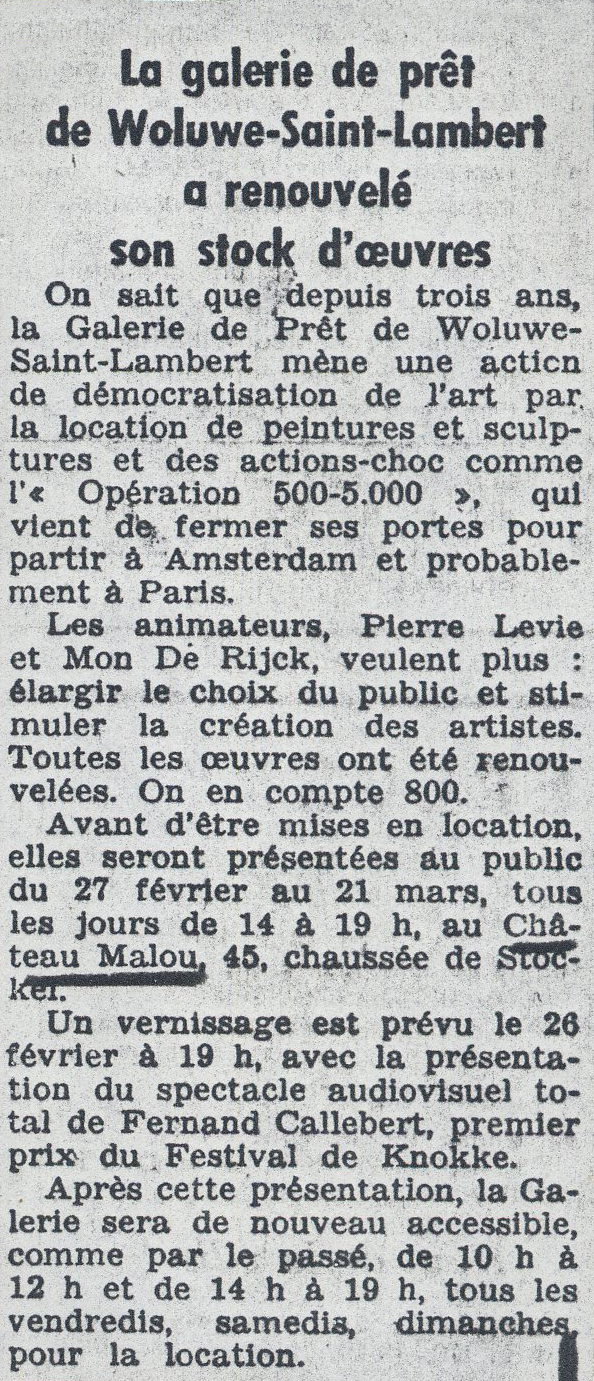
The love story of Léon
Article by Léon Weustenraad in Le Soir of 28 May 1988, devoted to the monument "The love story of Léon" erected in Josaphat Park, Schaerbeek. The municipality was able to raise the necessary funds in 1986, forty years after the testator's bequest. The maquette by sculptor Mon De Rijck, former director of the National Bronze Foundry, won the jury's favour: the 2.4-metre Carrara marble work took seven months to complete and presents a version of the Fountain of Love legend.
Read the articleThe Fountain of Love
Photograph by Jean Heylemans published in Le Soir of 28 May 1988: Mon De Rijck's Carrara marble monument in Josaphat Park, illustrating the Fountain of Love legend alongside the article "The love story of Léon" published the same day.
Read the article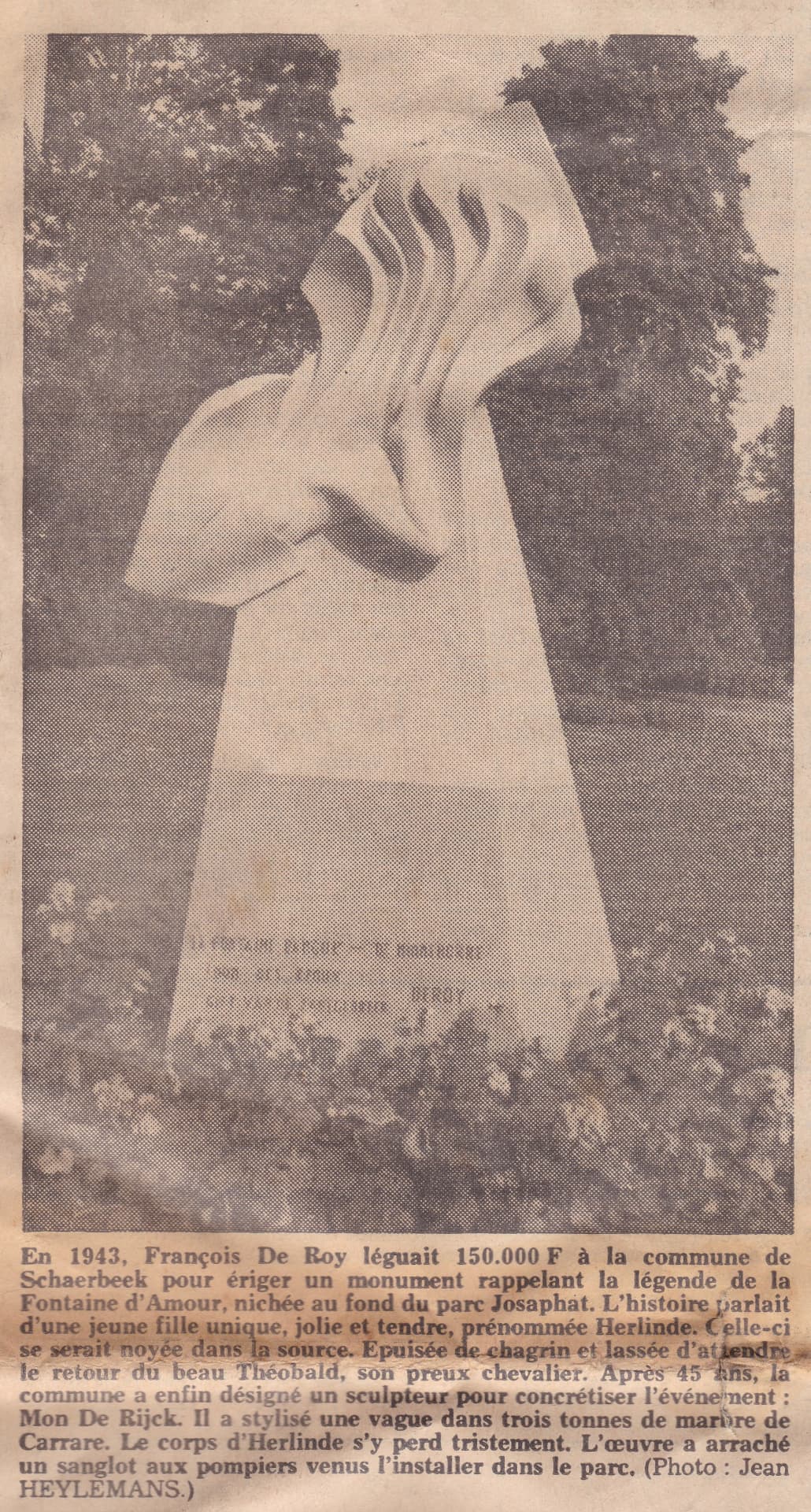
Art Pool Fraction: become a collector and patron for 500 francs a month!
Article by Jean-François Walhain presenting Art Pool Fraction, the instalment-based artwork acquisition scheme launched by the Art Pool artists' group, chaired by Jean-Charles d'Alcantara. Each artist has a "fraction" (maximum 100 members); the member pays a monthly "share" (300 to 3,000 F, e.g. 500 F) over five years, enjoys the work from the first year and becomes its owner at the end, at the fixed starting price even if the artist's value rises. The share entitles members to a profit participation (~0.5%) on the artist's sales, and the artist opens the studio to the fraction at least one day a month. The Art Pool Fraction exhibition room is the very house of the sculptor behind the project, Mon De Rijck, at 80 rue Gaucheret; four artists are presented each month, together with the monthly magazine "Ateliers". Art Pool had existed for five months and more than 40 artists had already applied. Until 15 April: Mon De Rijck and abstract painter Thomas Van Gindertael; from 19 to 24 April: Charline Mahy and Peter Van Gheluwe. To make an impression, the founders had mailed the 250 journalists a cobblestone stamped with the logo - "a nod to '68: Art Pool is a small revolution". Open daily from 2 to 7 p.m.
Read the article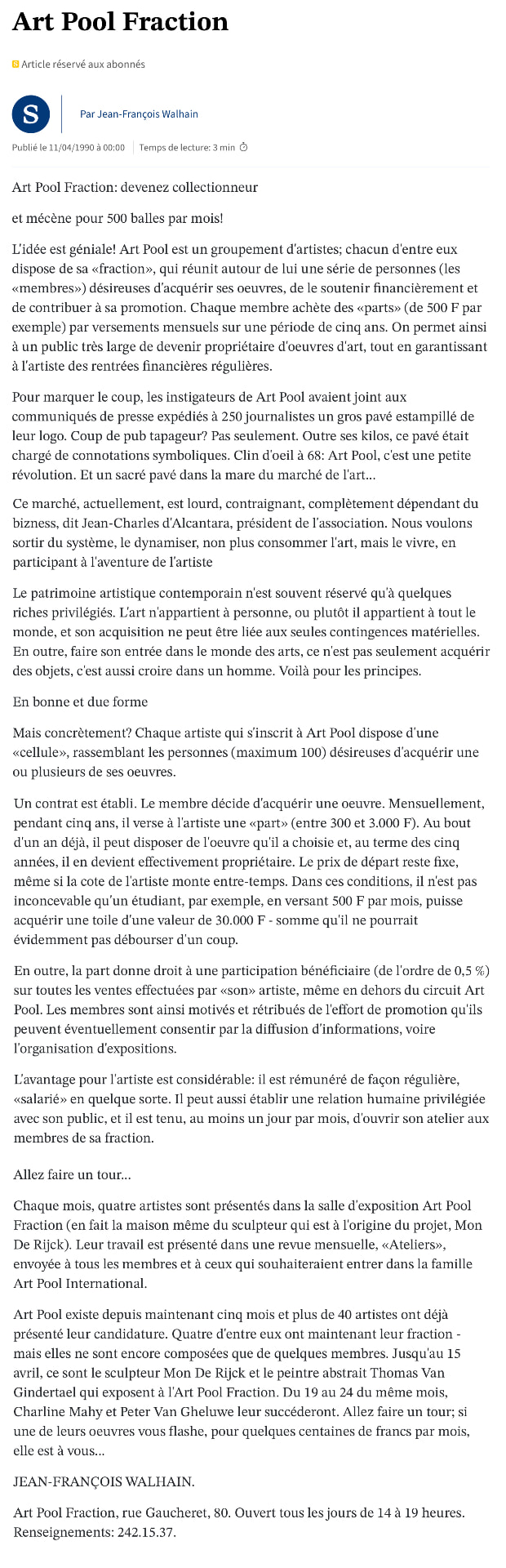
An artwork exchange fair where money and cheques are banned - Art-Pool brings the art of barter back into fashion
Article by Martine Duprez in Le Soir of 13 December 1991, devoted to Art-Pool's "truc-troc": an artwork exchange fair where money and cheques are banned. Artists exhibit their works on the ground floor at 80 rue Gaucheret; upstairs, members of the public deposit objects and offers of services in exchange. The article recalls that Art-Pool, a cooperative founded in March 1990 by sculptor Mon De Rijck, offers an acquisition system of monthly instalments of 500 or 1000 francs spread over five years. About a hundred proposals already recorded; the exchanges take place on 22 December at 2 p.m.
Read the articleArt Pool artists go on display in the North Quarter
Article by Martine Duprez in Le Soir of 12 March 1992, devoted to the "Extension Nord" exhibition, organised on the initiative of Mon De Rijck in the display windows of WTC 1, at the corner of Boulevard du Jardin Botanique and Boulevard Émile Jacqmain. The article recalls that Art Pool then brought together some 175 artists from all disciplines, aiming to make art accessible to as many people as possible by exhibiting it in public places. Pictured: Mon De Rijck's sculpture in the building's display window.
Read the article"Rupture de digue", an aquatic exhibition at Art Pool
Article by Martine Duprez in Le Soir of 6 June 1992, devoted to "Rupture de digue", an aquatic exhibition at Art Pool, rue Gaucheret 80 in Brussels: a room lined with silver paper, covered with about twenty centimetres of water, which visitors discover from a jetty. The article also presents the model of the "Grand A", Mon De Rijck's monument project along the canal - two barges raised vertically to form an A - and the postcard petition launched by Art Pool addressed to the Brussels Region. Exhibition open until 28 June 1992.
Read the articleAn original exchange fair - Art-Pool introduces the art of barter
Article by Martine Duprez in Le Soir of 18 December 1992, devoted to the second edition of Art-Pool's "truc-troc", the artwork exchange fair where money and cheques are banned. "Barter is not based on the financial value of the work but on falling in love with it," explains Françoise Laurent, a member of Art-Pool, while Mon De Rijck, one of the founders, urges the public to put their imagination to work. New this year: the exhibition is paired with an "Artists' Studios Fund" allowing visitors to acquire a work directly from the studios. Open until 27 December 1992, by appointment, with opening hours on Fridays and Saturdays from 2 to 7 p.m. and on Sundays 20 and 27 December from 11 a.m. to 2 p.m.
Read the articleA grandiose project named Grand A, like an ark along the canal
Article by Martine Duprez published on 22 May 1992. The first major public presentation of Mon De Rijck's "Grand A" project: a basin 135 m long, 10 m wide and 1 m deep along the canal at Quai des Péniches, with two 50-metre-high vertical barges forming a giant A and two more lying horizontally - one devoted to art, the other to the economy. Mon De Rijck, who lived on a boat for ten years, sees it as a signal and a new city gate: a venue for prestigious events, where each month a country would showcase an aspect of its economy and culture. The name evokes the structure's shape, the name of Mon De Rijck's boat and a set of symbols (the great architect, the great artist, the great love, the first letter of the alphabet). The team assembled around the project: the Schilling architecture office, engineers Pierre d'Haene and Verdeyen & Moenaert, developer Jean-Paul Rondiat and Bernard Mahy of PR firm Belgium Contact-Trimodia. Rondiat, a navigation enthusiast, holds the Quai des Péniches site through a long lease with the Société du canal; a moratorium now bans industrial activity (a gas depot) there, opening the way to a cultural use. Mahy stresses the art-and-commerce combination in the European dynamic, citing the Atomium. The budget reaches 70 to 80 million and requires a public partner (Brussels Region, French or Flemish Community, or Europe). Filed with the Brussels Region on 24 October 1991, the project draws little enthusiasm from the Picqué cabinet, Karl Lowette calling it unrealistic. To convince the authorities, Mon De Rijck plans to publish postcards of the project for citizens to send to Charles Picqué's office. The Grand A model will be presented to the public for the first time on Friday 5 June at 7 p.m., as part of the "Rupture de digue" exhibition, organised with the Art-Pool artists' collective at 80 rue Gaucheret, Schaerbeek.
Read the article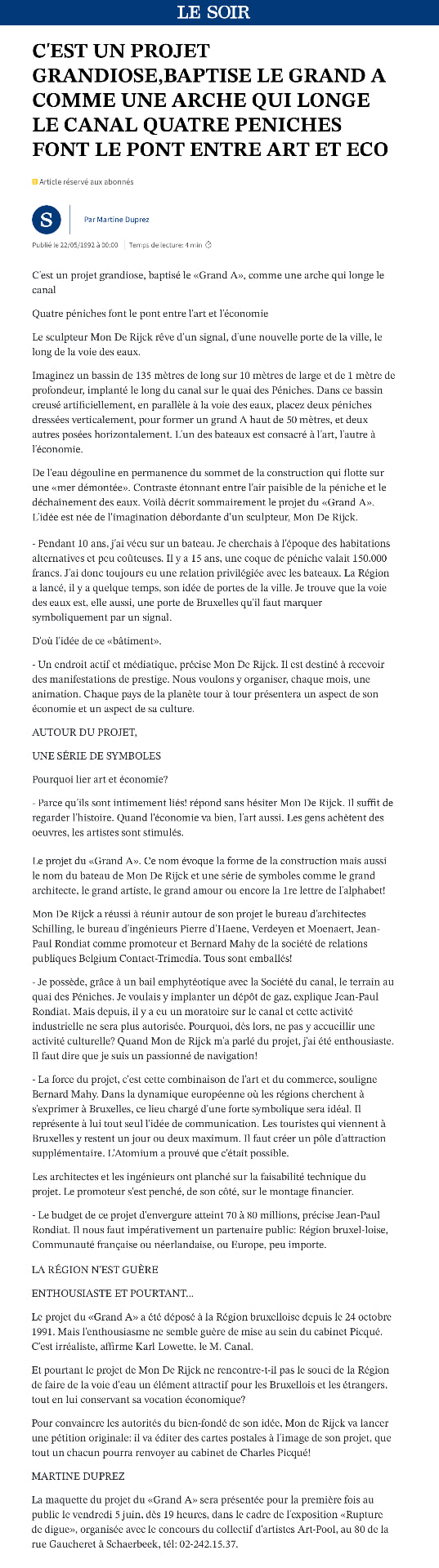
A bridge between art and economy
Dutch-language article ("Brug tussen kunst en ekonomie") about the "Dijkbreuk" exhibition by the Art Pool collective, riding on the inventiveness of sculptor Mon De Rijck. It discusses the Grand A project, whose model "already speaks volumes": two Rhine barges placed vertically against each other along the Akenkaai in the Quartier Nord, with two horizontal river barges at their base serving as exhibition spaces for the European regions - a project that "stands or falls with its subsidisation". The article describes the exhibition venue (a fine building by Alphonse Balat, a pupil of Victor Horta, in the Quartier Nord), Art Pool's rhythm (weekly changing exhibitions, an unusual major show every three months, including "Dijkbreuk" presenting the model) and quotes Mon De Rijck: "Culture and economy are inseparably linked and fertilise each other... hence the idea of combining both, visually and functionally, in the Grand A project."
Read the article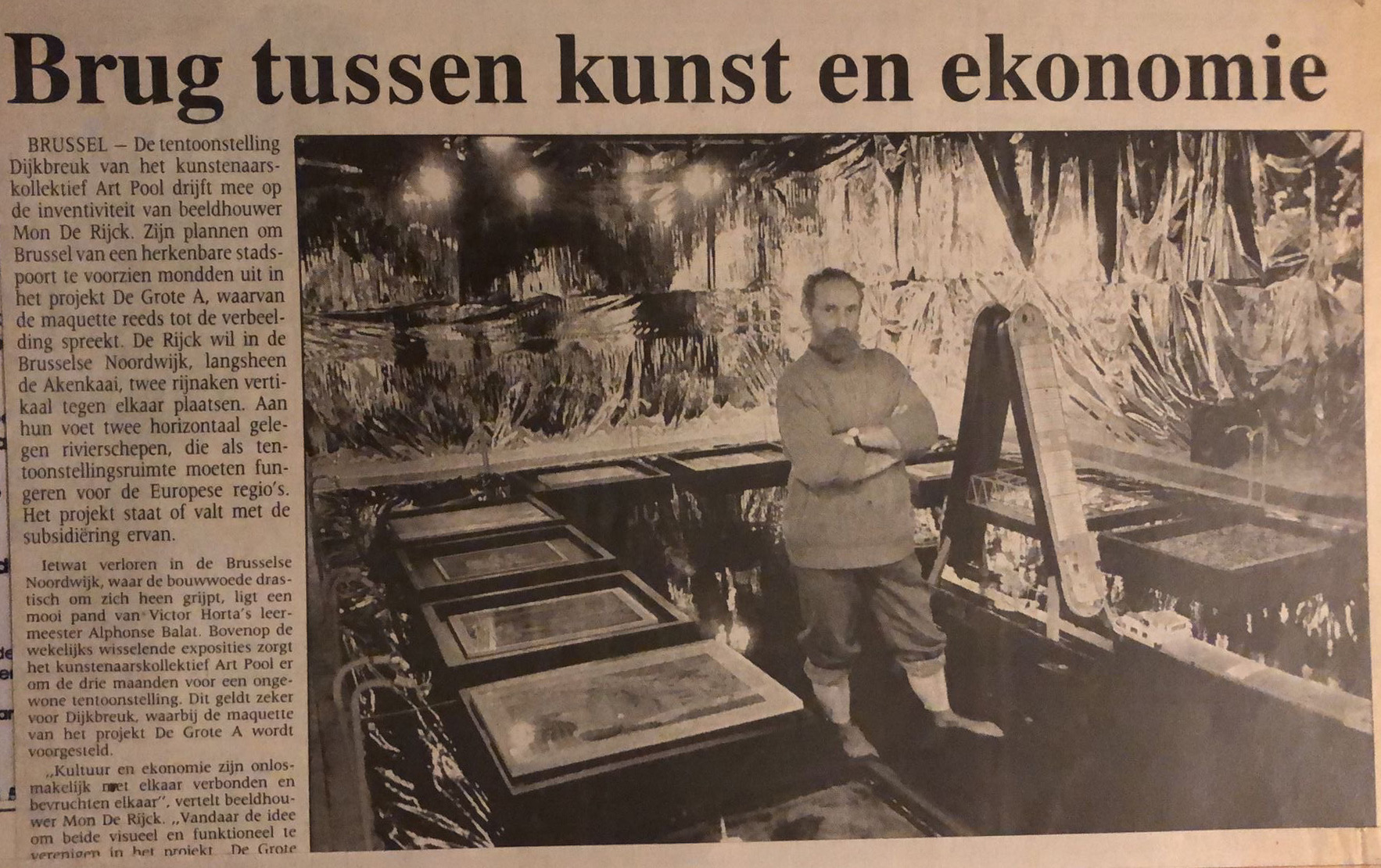
The environment? A work of art in itself!
Le Soir opens its Brussels section with the Brussels Region's stand at the Green Fair, the environment fair at the Heysel (22-26 October 1993): a 300 sq m artistic project designed by Mon De Rijck and the Art Pool collective (including Charline Mahy), with a recycling pyramid, a waterfall and the Carrara marble sculpture "The Mermaid". The public relations agency Belgium Contact, headed by Bernard Mahy, designed and coordinated the project for the cabinet of Environment Minister Didier Goswin.
Read the article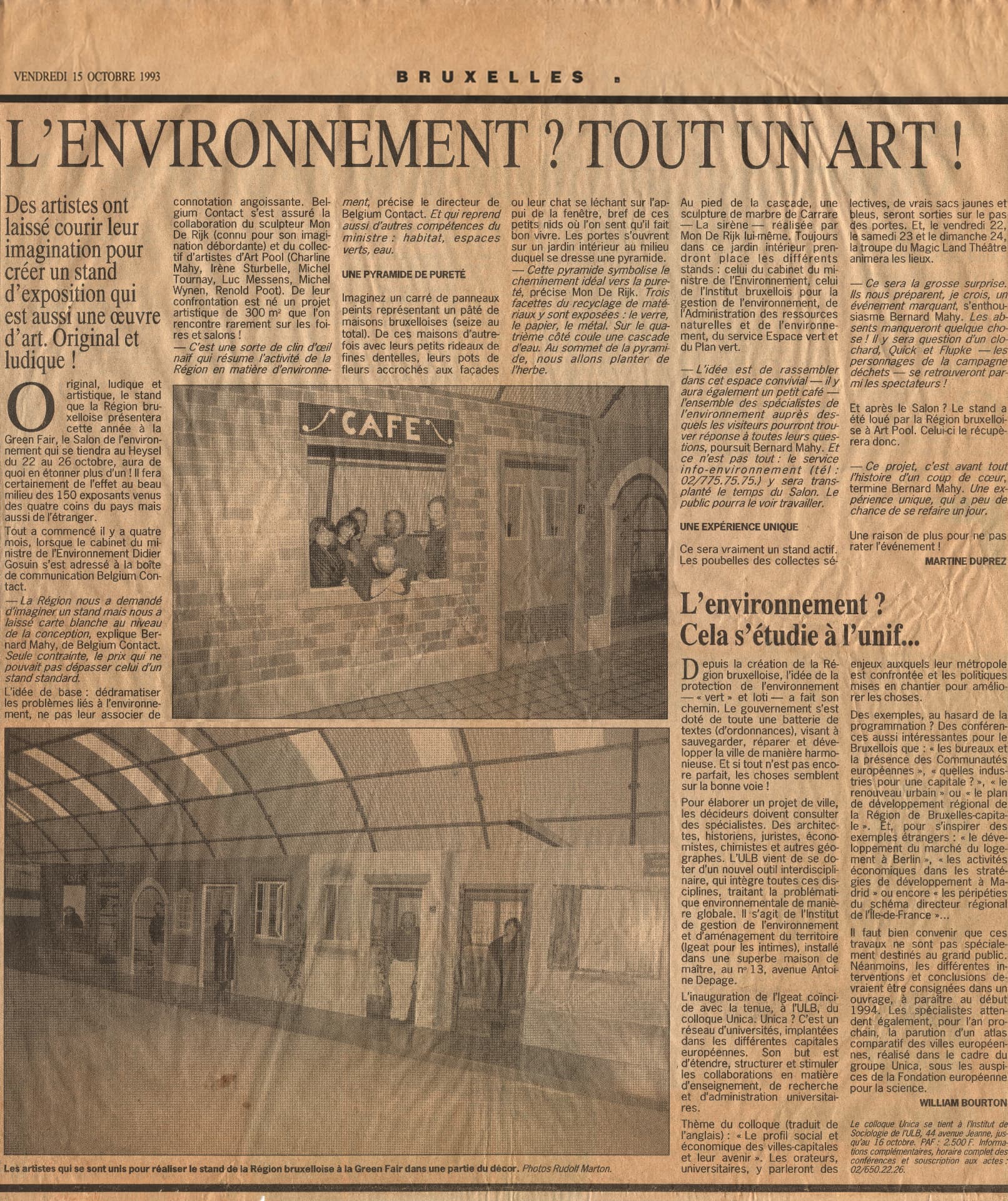
A naval embassy for the capital
Article by Pascal Sac announcing sculptor Mon De Rijck's four-year European economic and cultural crusade aboard Le Grand A, his barge converted into a travelling exhibition pavilion promoting Brussels: one year on Belgian rivers and canals, three years across Europe (Antwerp, Hamburg, Prague, Warsaw...). At each stop, the thirty works by ten Brussels artists would be joined for a month by local artists, with exhibitions, events, business meetings and official contacts. The expedition - catalogue, book and video reports - had to raise a budget of 10 million a year; Procter & Gamble had agreed, Nestlé was interested, and minister Didier Gosuin found the idea "thrilling". The article also mentions Art Pool, the art promotion cooperative founded by Mon De Rijck (80 rue Gaucheret, 1210 Brussels), and his land-based operations of 1976 and 1978 in South America and Asia.
Read the article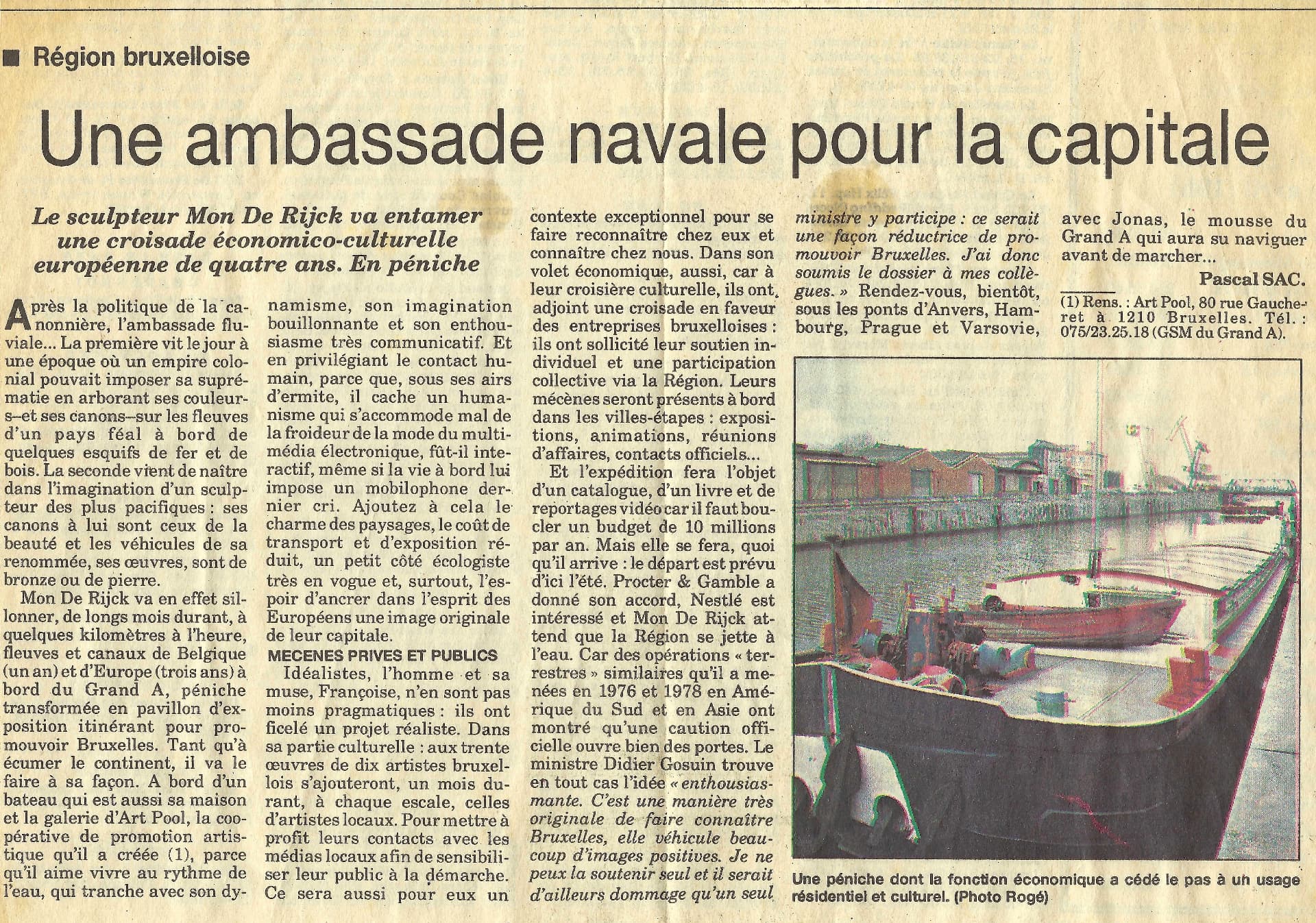
The Art-Pool gallery celebrated its second birth on the canal - an embassy of Brussels art along the water
Article by Martine Duprez published on 5 February 1994. Art-Pool, the artists' cooperative set up by Mon De Rijck and his partner Françoise Laurent at 80 rue Gaucheret in Schaerbeek (monthly-contribution artwork purchase scheme), celebrates its "second birth": after more than a year of slowing down to prepare its reconversion, the gallery goes afloat. Mon De Rijck, "gripped by the call of the open sea", found a new barge and converted it into an art gallery and home - Mon, Françoise and Jonas, their 15-month-old toddler, have taken up residence there. The floating gallery is moored at Quai des Péniches, a stone's throw from Place Sainctelette, level with the "Empire" nightclub. For the inauguration, the sculptor shows a retrospective of his last ten years (tin, bronze and marble sculptures, sketches of female bodies, "sensually beautiful") alongside watercolours by Irène Sturbelle, with whom he had exhibited exactly 14 years earlier on his first barge. Two further exhibitions are planned for April and May. Mon De Rijck then plans to move the barge to the Bryck, beside the Van Praet bridge - a better-known spot more likely to draw visitors - before taking to Belgium's canals with a travelling exhibition: "a dress rehearsal before the big plunge: a cultural and economic embassy across Europe (Amsterdam, Paris, Berlin, Vienna and Prague)". He announces reviving the Grand A idea: the barge would become the floating ambassador of the Brussels Region, with support from public authorities and private firms, shows devoted to Brussels artists and presentations of dynamic Brussels companies eager to export. "Cast off and away she goes!" Practical details: Art-Pool, aboard the M/S "Le Grand A", Quai des Péniches, tel. 075-23.25.18, until 28 February, open Friday, Saturday and Sunday from 2 to 7 p.m.
Read the article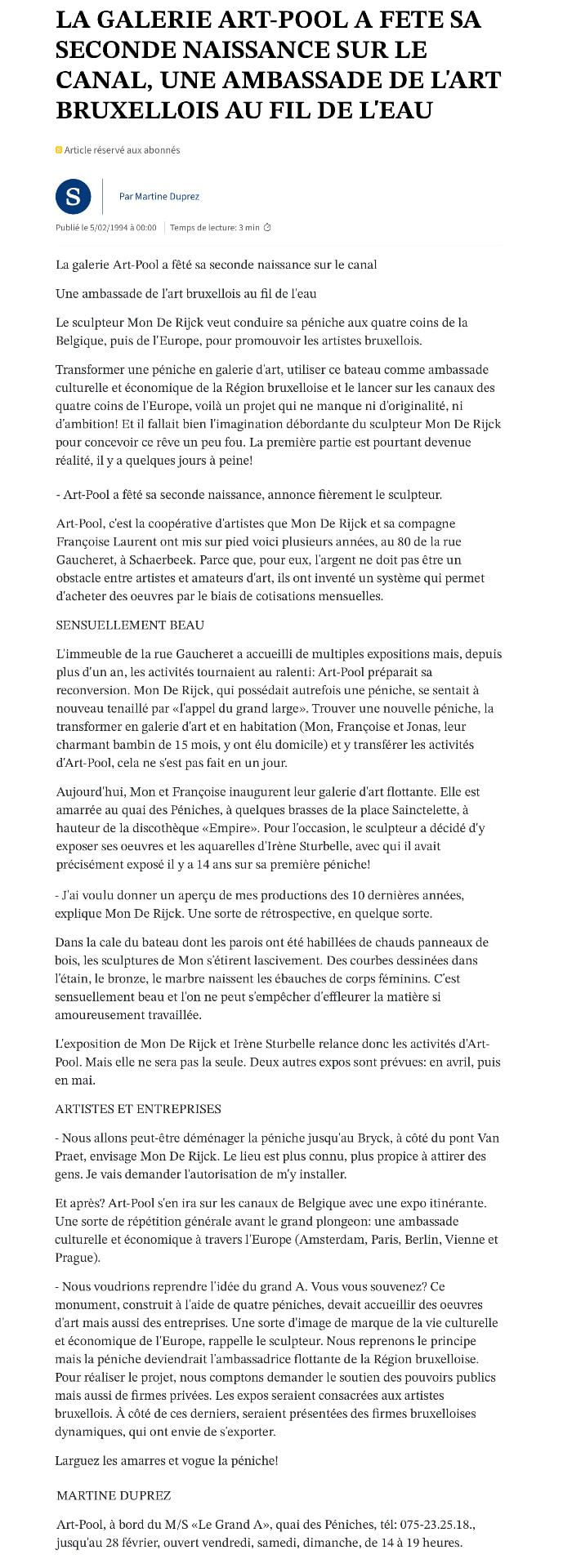
Midas is back, I met him...
Full-page portrait of Mon De Rijck: the sculptor and bargeman who "breathes life into everything he touches" - into bronze, into barges bound for the scrapyard, into a slum in the Quartier Nord and into art itself. The article details his Le Grand A project (a 150 m long, 50 m high sculpture made of two barges raised vertically in the shape of an A, linking two further exhibition boats, to be erected in a Quartier Nord dock), his working stays in Carrara, the Château Malou art lending gallery launched in 1972, Mécénat démocratique co-founded in 1970 and Art Pool, the monthly-subscription artwork acquisition scheme launched in late 1989.
Read the article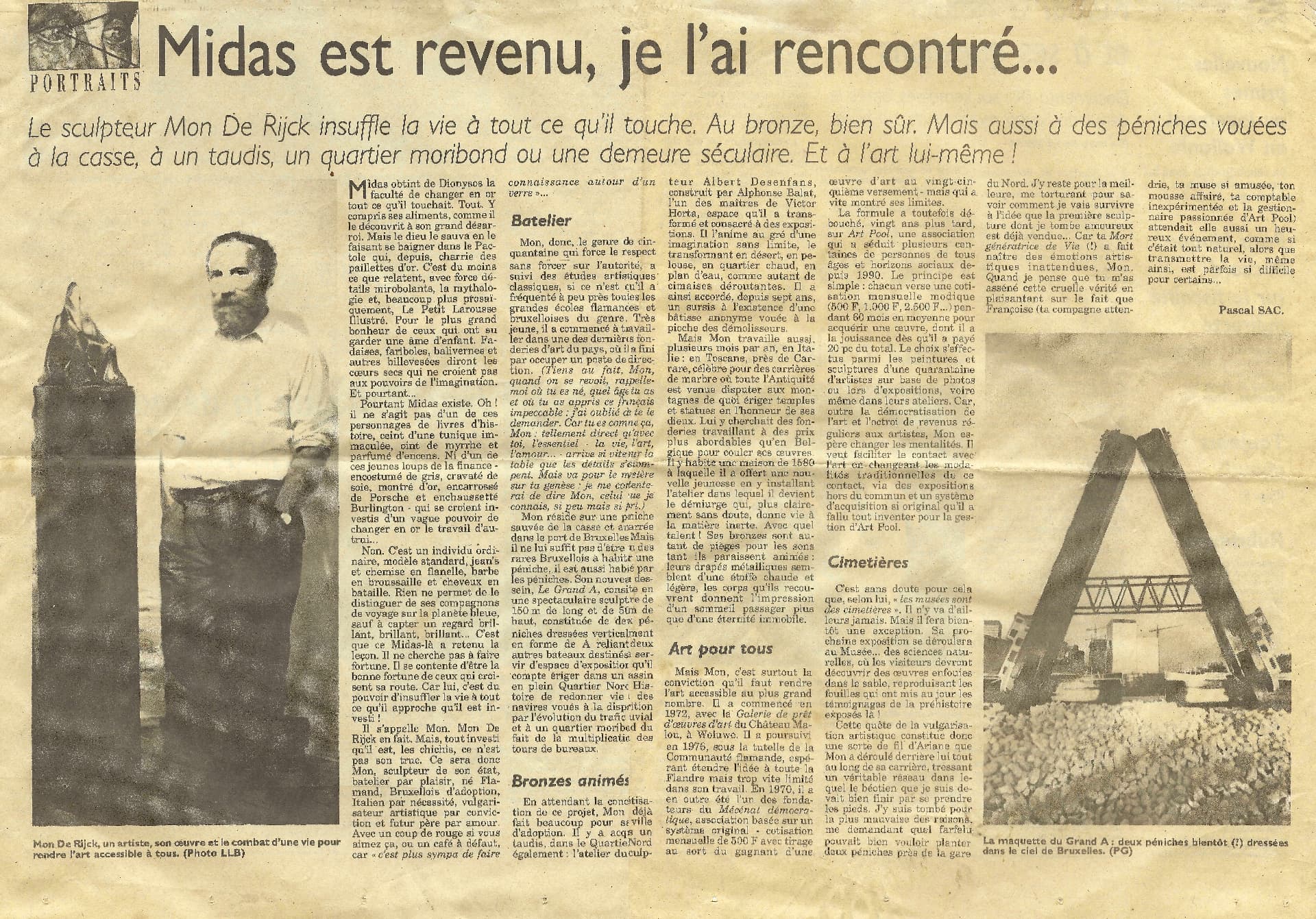
Tauschhandel - The Art Truc Troc art fair in Brussels
The German magazine kunnst devotes a double-page spread to Art Truc Troc on the occasion of its 11th edition at Bozar, from 16 to 18 January 2015. The article explains the artwork barter principle via Post-it notes, recalls the history of the concept (created in 1975 at Château Malou by Mon de Rijck and Charline Mahy, continued by the GPOA gallery in 1976, relaunched in 2004 with over 100 artists and 4,000 visitors, over 20,000 visitors in 2013) and announces more than 300 artists for 2015, with design (in cooperation with MAD Brussels), performance and music sections, performance focusing on dance with a workshop for young choreographers.
Read the article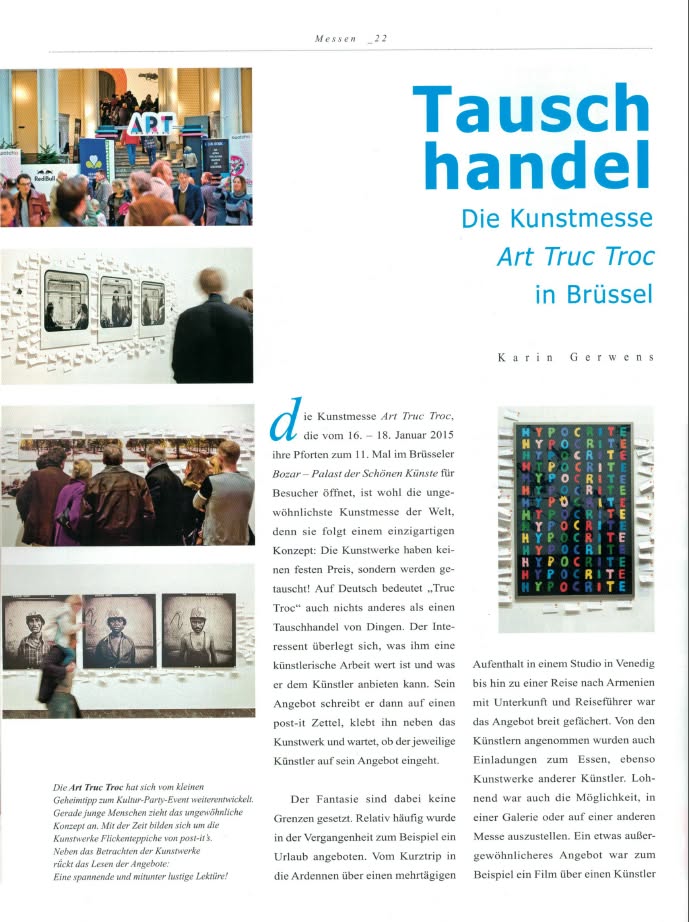
The "anti-anti-painting" exhibition at château Malou: ten young Belgian painters of the new generation
Mon De Rijck, director and organiser of the château Malou artwork lending gallery, brings together ten easel painters of the young generation in the exhibition "L'anti-anti-peinture", open until 18 April. The article recalls that the gallery was created in 1972 at Mon De Rijck's initiative with the support of the municipal authorities, describes the rental formula (250 F registration fee, 100 F per work per month, maximum three months, with an option to buy) and cites the Truc-troc and the 500-5000 operation as further initiatives to make art accessible to all.
Read the article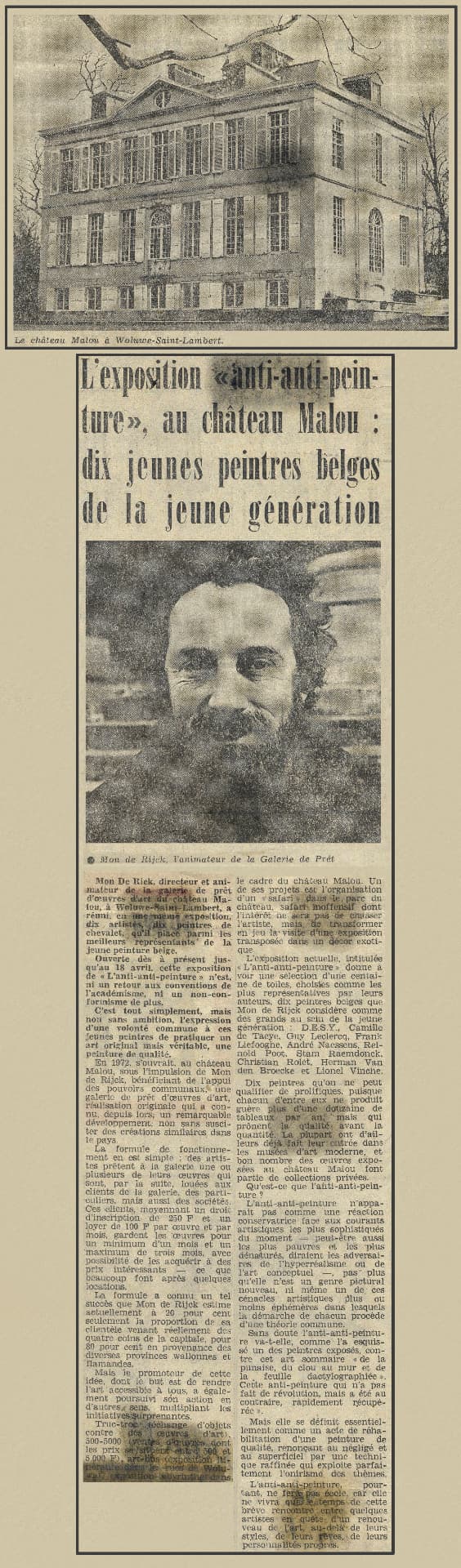
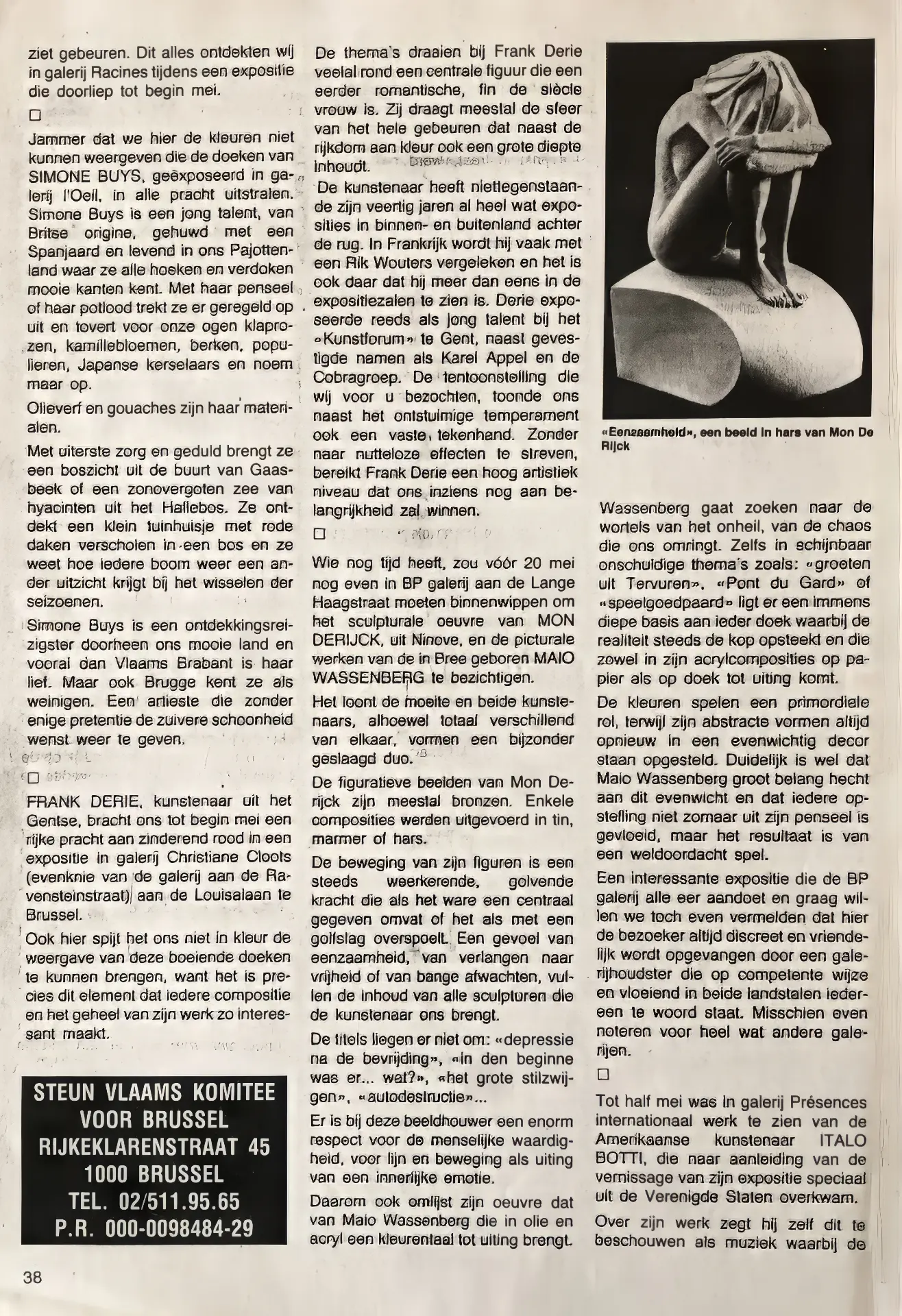
Mon De Rijck and Maio Wassenberg exhibition at the BP gallery, Lange Haagstraat
Dutch-language column inviting readers to visit the BP gallery, Lange Haagstraat, before 20 May to discover the sculptural work of Mon De Rijck, "from Ninove", alongside paintings by Maio Wassenberg, born in Bree - "a particularly successful duo". The author describes Mon De Rijck's figurative sculptures, mostly bronze, some in tin, marble or resin; the movement of his figures, an "ever-recurring undulating force", conveys a feeling of solitude ("eenzaamheid"), a longing for freedom or anxious expectation. Titles cited: "depressie na de bevrijding", "in den beginne was er... wat?", "het grote stilzwijgen", "autodestructie". The column praises the sculptor's respect for human dignity, line and movement as the expression of inner emotion, and notes the gallery owner's discreet, bilingual welcome. The same page mentions Simone Buys (galerie l'Œil), Frank Derie (galerie Christiane Cloots, avenue Louise) and Italo Botti (galerie Présences).
Read the article