What you don't see behind the party
Setbacks & comebacks
In the world of nightlife and events, we are often seen as people who shine, stringing together successes and stimulating projects. But the reality of the job is quite different: it is first and foremost a daily life where you have to absorb the unexpected, protect your teams and face bad faith as well as external pressures.
Behind the festive image and the reputation of a venue lies a permanent crisis management:
- Hasty accusations: A forgotten jacket or a lost wallet immediately becomes a "theft" blamed on the staff. A month later, the customer reluctantly admits that he had simply left it in his trunk or under a car seat. No apology is offered, but the damage is done.
- Viral crisis management: A rejected customer invents a narrative of discrimination on social media. Faced with a nascent bad buzz, no sterile debate: the methodical extraction of images and sound from the CCTV footage now makes it possible to re-establish the facts instantly. Result: the post is deleted under threat of the truth being broadcast.
- Friction with neighbours and neighbourhood committees: Running a venue or an event is also about daily diplomacy. Between residents, neighbourhood committees and administrative requirements, maintaining the balance between nightlife and local tranquillity is a constant challenge.
- Unfair competition and targeted attacks: The sector is not immune to low blows. You also have to learn to absorb campaigns of fake negative reviews or denigration orchestrated by competitors on social media to destabilise an establishment.
Running nightlife and events is not just about partying: it's about keeping a cool head, staying the course and turning tension into methodical and rigorous management.
1995
The parody leaflets of the Who's Who's Follies, at the Fuse
In 1995, while the Who's Who's Follies nights produced by Carl De Moncharline at the Fuse, rue Blaes in Brussels, were selling out, two anonymous leaflets were printed and left on car windscreens. They borrowed the graphic signature of the parties to turn it against their producer. The authors were never identified; Carl De Moncharline kept both copies.
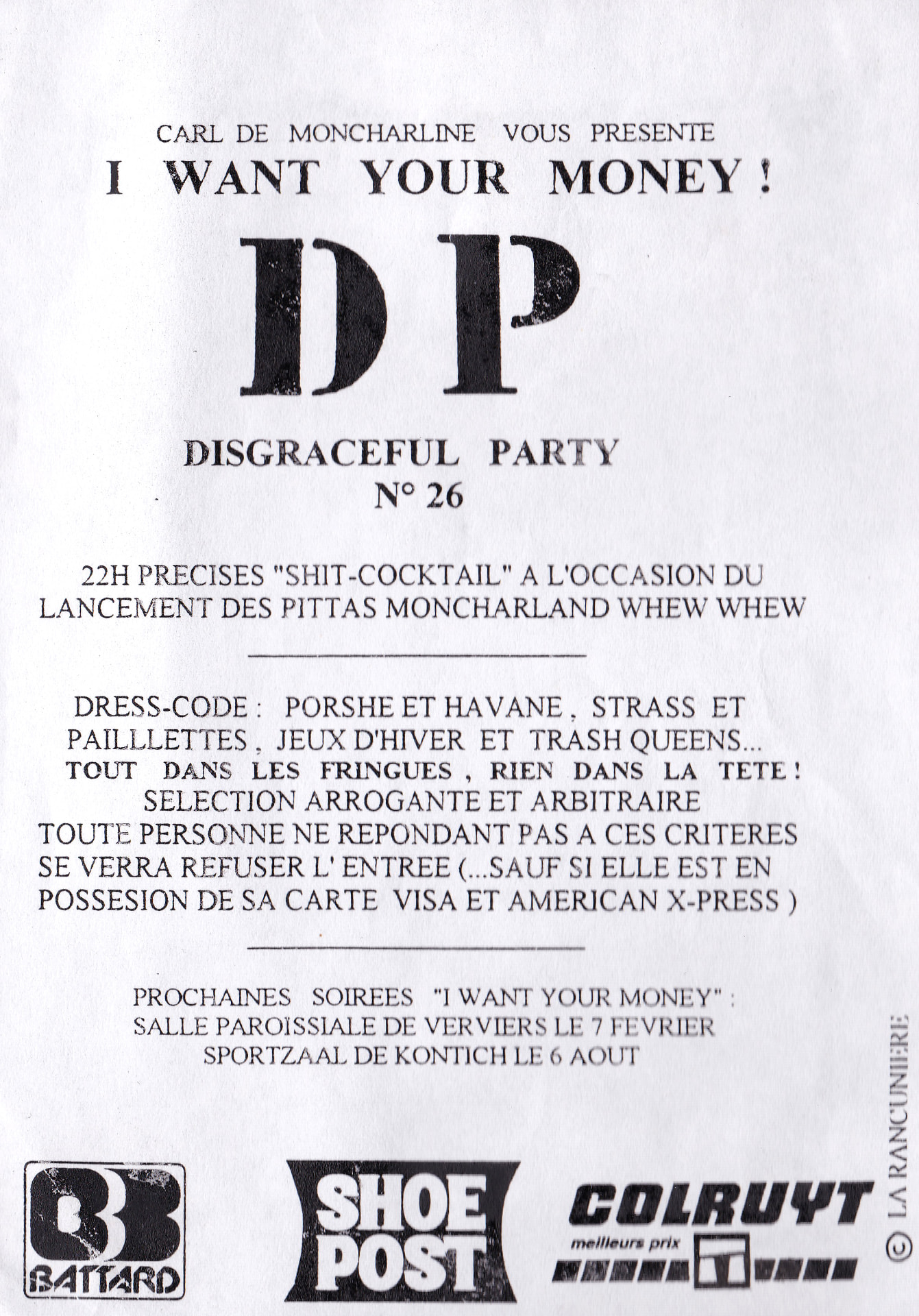
“I Want Your Money!”: Disgraceful Party no. 26
Parody flyer, 1995. Carl De Moncharline private collection
Printed in black and white as a direct parody of the Who's Who's Follies flyers at the Fuse, rue Blaes in Brussels. Carl De Moncharline's name appears verbatim at the top, followed by the slogan “I WANT YOUR MONEY!”.
The text mocks the door policy itself: “dress-code”, “arrogant and arbitrary selection”, entry refused “unless you hold a Visa and American X-Press card”. The leaflet was slipped under car windscreens around the parties.
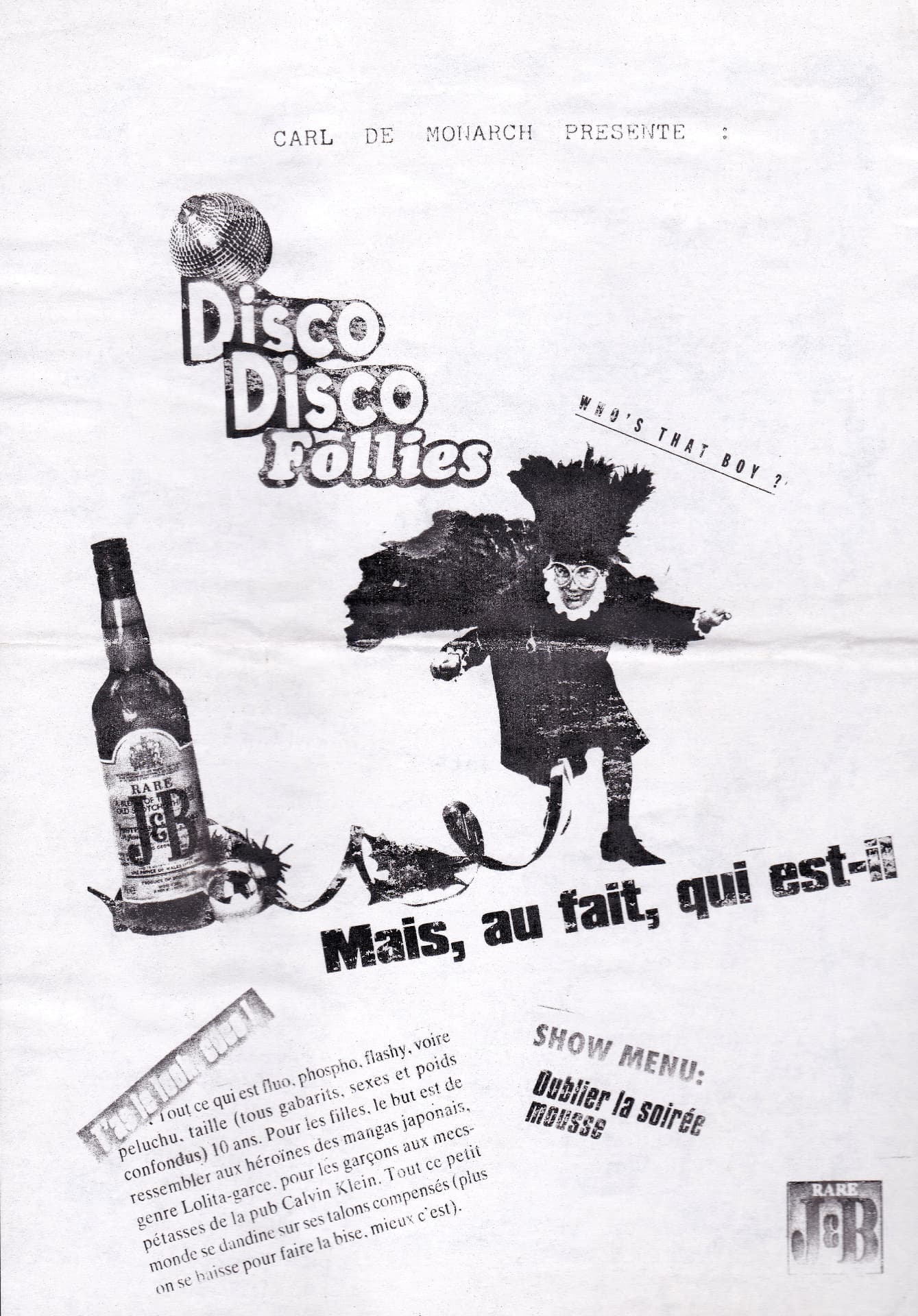
“Carl de Monarch presents: Disco Disco Follies”
Parody flyer, 1995. Carl De Moncharline private collection
A second leaflet, built on the Disco Follies logo and layout. The name is twisted into “Carl de Monarch”, with a photocopied caricature and the taglines “Who's that boy?” and “Mais, au fait, qui est-il?”.
It goes on with a fake dress-code (“anything fluo, phospho, flashy, even fluffy”) and a “show menu” reduced to one line: “Forget the foam party”. The target is obvious: the formats that were working at the time, Mousse extra and the Who's Who's Follies.